

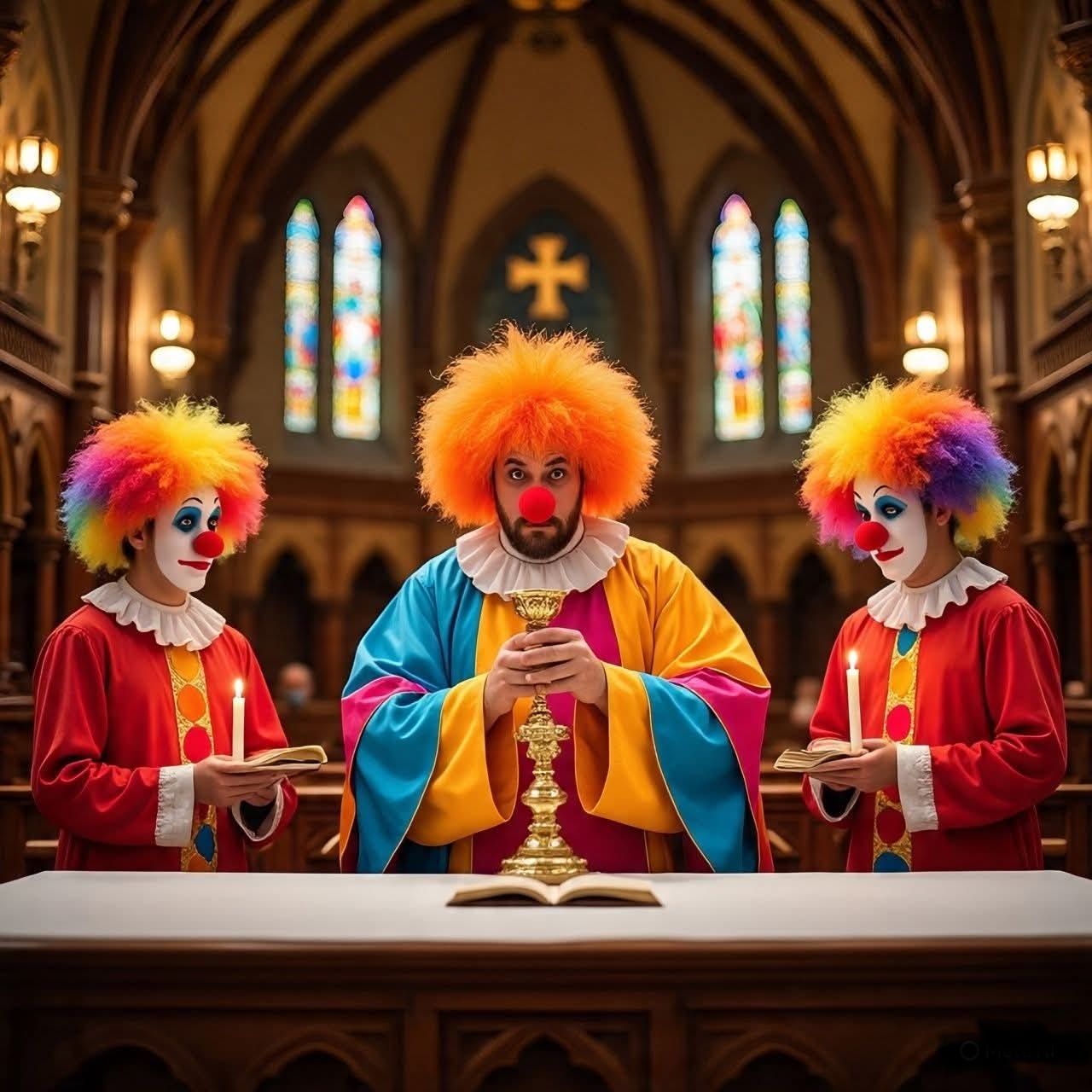
I write this, coincidentally, on the morning after having assisted at a Solemn High Mass on the Feast of the Immaculate Conception of Our Lady.
Even now, hours later, my soul still longs to return—to last night, to that sacred time and place where heaven bent low toward earth. There was something so rare, so saturated with reverence and beauty, that the heart instinctively understands it has tasted a small foretaste of eternity. Such is the gift granted by the Mass of the Ages.
Whether one possesses an intellectual grasp of every rubric, gesture, or whispered prayer of this venerable liturgy is, in a sense, secondary. The Traditional Latin Mass operates on a level deeper than explanation. On a purely experiential level—on the level of worship rather than analysis—it is impossible to leave this treasure of the Faith without the unmistakable awareness that one has participated in something truly other. Something awesome, transcendent, and fearsome in the proper theological sense. One knows that he has stood, however unworthily, before the throne of a Terrible and Majestic God, and that such an encounter demands nothing less than total reverence, humility, and awe.
I could continue at great length extolling the beauty, theological depth, and supernatural orientation of the Traditional Latin Mass. Volumes have already been written on the subject, and rightly so. But that is not, strictly speaking, the purpose of this little series. Rather, my intention is to examine the stark contrast between this sacred inheritance and what came to “replace” it: the impoverished, valid but illicit, neo-Protestant construction known as the Novus Ordo Missae.
This replacement occurred despite the solemn decree of Pope Saint Pius V in Quo Primum Tempore (14 July 1570), which promulgated the standardized Roman Missal of the Tridentine Liturgy and mandated its exclusive use throughout the Latin Church. This papal bull explicitly forbade any additions, subtractions, or alterations to the Mass, invoking the wrath of Almighty God upon those who would dare to tamper with it. But such warnings carry little weight among modernists—perhaps because belief in a God who is truly demanding and just, has long since been replaced by a more accommodating and domesticated deity of their own making.
While I presume that a significant portion of Radical Fidelity’s readership already understands why the Traditional Latin Mass is most pleasing to God—and recognizes the serious defects of the Novus Ordo—there remains a substantial number of faithful Catholics who sincerely ask, often in the comment section: “What is so wrong with the Novus Ordo Mass?”
It is for these brothers and sisters, and for others within your own families and circles of influence who “just don’t get it yet,” that this series is written. My aim is to provide clear, accessible explanations of the elementary theological, liturgical, and spiritual problems inherent in this pseudo-Catholic rite.
Please do share these articles with those who are searching, questioning, or unsettled. Truth, once encountered, has a way of refusing to remain silent.
Theological, Liturgical, and Ritual Rupture
For most of her history, the Church prayed as she believed, and believed as she prayed. The Roman Rite did not arise from theory or committee, but from centuries of use, sacrifice, and sanctification. Each gesture, prayer, and silence bore the marks of generations who had knelt, whispered, and offered the Holy Sacrifice amid persecution, plague, revolution, and peace. The liturgy was not a text to be revised but an inheritance to be received.
The promulgation of the Novus Ordo Missae in 1969 marked a decisive break with that inheritance. The reform was unprecedented in scale, speed, and method. In the years that followed, traditional Catholic writers observed not merely cosmetic change but theological and ritual displacement. The following sections examine the most frequently cited and foundational problems raised, beginning with the heart of the matter: sacrifice.
I. The Obscuring of the Sacrificial Nature of the Mass
At the center of criticism lies a single, grave concern: the fact that the Novus Ordo Missae obscures the Mass as a propitiatory sacrifice. The traditional Roman Rite spoke insistently, even relentlessly, of sacrifice. From the opening ascent to the altar through the final proclamation of the Gospel of St John, the liturgy proclaimed that Calvary was being made present, unbloody yet real, offered by Christ through the hands of the priest for the sins of the living and the dead.
This sacrificial clarity was most evident in the Offertory. In the traditional Mass, the priest offers the host as a “spotless victim” and explicitly names his “innumerable sins, offenses, and negligences.” The chalice is offered “for our salvation and for that of the whole world.” The language leaves no ambiguity. What lies upon the altar is already designated for sacrifice.
In the Novus Ordo, these prayers were entirely removed and replaced with new formulas drawn from Jewish table blessings: “Blessed are you, Lord God of all creation, for through your goodness we have received the bread we offer you.” These words are not intrinsically erroneous, but they are not sacrificial. They speak of gifts, not victims; of nourishment, not immolation; of human labor, not divine propitiation. This change shifts the theological axis of the rite, subtly relocating the meaning of the Mass from sacrificial offering to communal meal.
This shift is reinforced by the proliferation of Eucharistic Prayers. The Roman Canon, virtually unchanged for fifteen centuries and saturated with sacrificial language, was no longer normative. In practice, it is often replaced by Eucharistic Prayer II, the shortest and least explicit in its sacrificial expression. The result is not formal denial but habitual attenuation: a sacrifice that must be inferred rather than declared.
II. The Diminution of the Ministerial Priesthood
Closely tied to the sacrificial question is the role of the priest himself. In the traditional rite, the priest stands unmistakably as mediator. He ascends the altar steps alone, whispers prayers the people may not hear, and offers sacrifice on their behalf. His posture, silence, and separation from the congregation signify a theological reality: he acts in persona Christi, not merely as a delegate of the assembly.
The Novus Ordo reshapes this dynamic. From the opening greeting onward, the priest is positioned as presider, facing the people, speaking constantly (including joking), and engaging in dialogue. Lay ministers assume roles once reserved to clerics, not only reading Scripture but distributing Holy Communion and handling the sacred vessels. The careful ritual discipline that once emphasized the priest’s consecrated hands—fingers joined after the consecration, avoidance of unnecessary contact with sacred species—is largely absent.
Thus the priesthood isn’t explicitely denied, but its distinctiveness is blurred and watered down. When the priest appears functionally interchangeable with lay participants, his unique sacrificial role becomes less visible. Over time, visibility shapes belief. A priest who looks like a chairman begins to be understood as one.
III. The Weakening of Eucharistic Reverence and the Real Presence
The doctrine of the Real Presence remains officially affirmed, yet the ritual expression has been significantly weakened. In the traditional Mass, reverence is built into every movement.
In the Traditional Latin Mass, the priest’s bodily reverence before the Real Presence is strikingly manifest in the sheer number of mandated genuflections. During the Mass itself—whether Low Mass or Solemn High Mass—the celebrant genuflects approximately seventeen times, not counting additional genuflections made when approaching or leaving the altar if the Blessed Sacrament is present. These genuflections occur at decisive theological moments: whenever the priest passes before the Sacrament, after each elevation of the Host and the Chalice, repeatedly throughout the Canon, and before and after his own Communion. By contrast, in the Novus Ordo Missae, the priest is required to genuflect only three times during the Mass: after the elevation of the Host, after the elevation of the Chalice, and following the Agnus Dei at “Behold the Lamb of God,” immediately before his Communion. This represents a reduction of roughly eighty percent, a change that is far from incidental. Genuflection is not a mere ceremonial flourish but a bodily confession of faith—lex orandi, lex credendi. The Traditional Mass, through its repeated acts of kneeling, trains the priest to worship as though Christ is truly, substantially present upon the altar, because He is; the Novus Ordo, in contrast, reduces this posture of adoration to a minimum obligation, subtly reshaping the liturgy’s emphasis from sacrifice to assembly and contributing to the wider erosion of Eucharistic faith.
Furthermore, the faithful kneel to receive Holy Communion on the tongue. The tabernacle stands at the center of the sanctuary, marked by a burning lamp and flanked by candles.
By contrast, the Novus Ordo allows Communion to be received standing and in the hand, often from lay ministers. In countless churches, the tabernacle has been displaced from the central axis or removed entirely to a side chapel. These practices are not mandated by the Missal, yet they have become normative.
Doctrine does not live in texts alone. It lives in habit, gesture, posture, and silence. When the faithful are no longer trained to kneel, to adore, and to approach with fear and trembling, belief in the Real Presence predictably erodes. The widespread collapse of Eucharistic faith in the decades following the reform is cited not as coincidence, but as consequence.
IV. Ecumenical Dilution and Protestant Sensitivity
Another wretched aspect of the new “Mass” is the ecumenical orientation of the reform. The involvement of Protestant observers in the drafting of the new rite, while officially consultative, has never ceased to raise suspicions. More significantly, the resulting liturgy appears to downplay precisely those elements historically rejected by Protestant theology: sacrificial language, priestly mediation, and the notion of propitiation.
This concern is not speculative. Statements from the period reflect an explicit desire to remove “obstacles” to ecumenical dialogue. In doing so, the reform mutes aspects of Catholic worship that were not peripheral but constitutive. A Mass that can be easily recognized by a Protestant minister as acceptable is already a very concerning compromised sign.
V. The Loss of Sacred Language and Hieratic Expression
Language shapes consciousness, and the abandonment of Latin represents one of the most visible breaks with tradition. Latin was never merely a utilitarian tool; it was a sacral language, set apart from daily speech, immune to colloquial drift, and universally unifying. It bound Catholics across centuries and continents to the same words, the same prayers, the same cadence of worship.
The vernacularization of the Mass fractured this unity. Early translations frequently sacrificed precision for accessibility, most notoriously rendering pro multis as “for all,” a mistranslation that persisted for decades. Prayers once dense with theological content were flattened into functional prose. Invocations of angels, saints, and cosmic intercession were abbreviated or removed.
When the language of worship becomes indistinguishable from ordinary speech, the sense of sacred otherness inevitably diminishes. The Mass begins to sound like something spoken about God rather than to Him.
VI. Excessive Optionality and Liturgical Fragmentation
The Novus Ordo Missae is defined by choice. Multiple penitential rites, multiple Eucharistic Prayers, variable readings, optional gestures, and extensive permission for adaptation create a rite without a fixed identity. One could almost say there exists no such thing as a standard Novus Ordo Missae! Two parishes in the same diocese may celebrate Mass in ways so different as to appear to belong to different religions.
In the traditional Roman Rite, stability was formative. The faithful learned the Mass by repetition. The priest submitted to the rite rather than shaping it. In the new liturgy, personality and preference often fill the vacuum left by prescription.
In this liturgical relativism the Mass becomes a platform for local creativity rather than a received act of worship. The priest chooses, adapts, and improvises. The faithful encounter not the Roman Rite, but a version of something else.
VII. Simplification and the Loss of Ritual Density
Finally, the systematic simplification of the liturgy is lamentable. Prayers at the foot of the altar, Psalm 42, multiple signs of the Cross, ritual kisses of the altar, and the Last Gospel were not decorative excesses but theological pedagogy. They embodied humility, preparation, reverence, and contemplation.
Their removal produced a rite that its proponents argue is “shorter, clearer, and more accessible”, but ultimately thinner and impoverished leaving the participants spiritually malnourished. Silence has been reduced. Gesture has been minimized. The Canon, once wrapped in reverent quiet, is now proclaimed aloud. Mystery yields to explanation.
The traditional Mass did not explain itself; it enacted itself. Its meaning was not disclosed through commentary but through form. In simplifying the rite, the reform stripped it of precisely those elements that formed souls over time.
What emerges from these first seven sections is not a list of disconnected grievances but a single diagnosis: rupture. A rupture in sacrificial emphasis, in priestly identity, in Eucharistic reverence, in sacred language, in ritual stability, and in symbolic depth. Whether one judges this rupture justified or catastrophic lies beyond this essay’s scope. What cannot be denied is that it occurred, and that its effects have been profound.
Part II will continue by examining the historical, pastoral, sociological, and aesthetic consequences of this rupture, moving from structure to fruit, from reform to aftermath.
Our Lady, Co-redemptrix, pray for us…
Our Lady, Mediatrix of all Graces, pray for us…
Viva Christo Rey!
Also Read:
“Christ is a Failed Individual” and Other New Blasphemies from the Synodal Dumpster Fire
Is This the Sanest Position for Faithful Catholics to Hold Regarding Post-Conciliar Popes?
Pope Claims Christians and Muslims Worship Same God at Interfaith Spectacle in Beirut
The first of the Spiritual Works of Mercy is “Instruct the Ignorant.” In our therapeutic culture we shy away from that “I-word” as if it’s a put down. It can be. It is not in this context. It refers to those impoverished and misled by being fed only what lacks in essential Truth. Your essay, and the planned series of which it is part, are thus a great Charity towards healing this great hunger. Thank you and God bless you!
Thank you for this discussion. It is answering a prayer I wasn’t aware I prayed.