

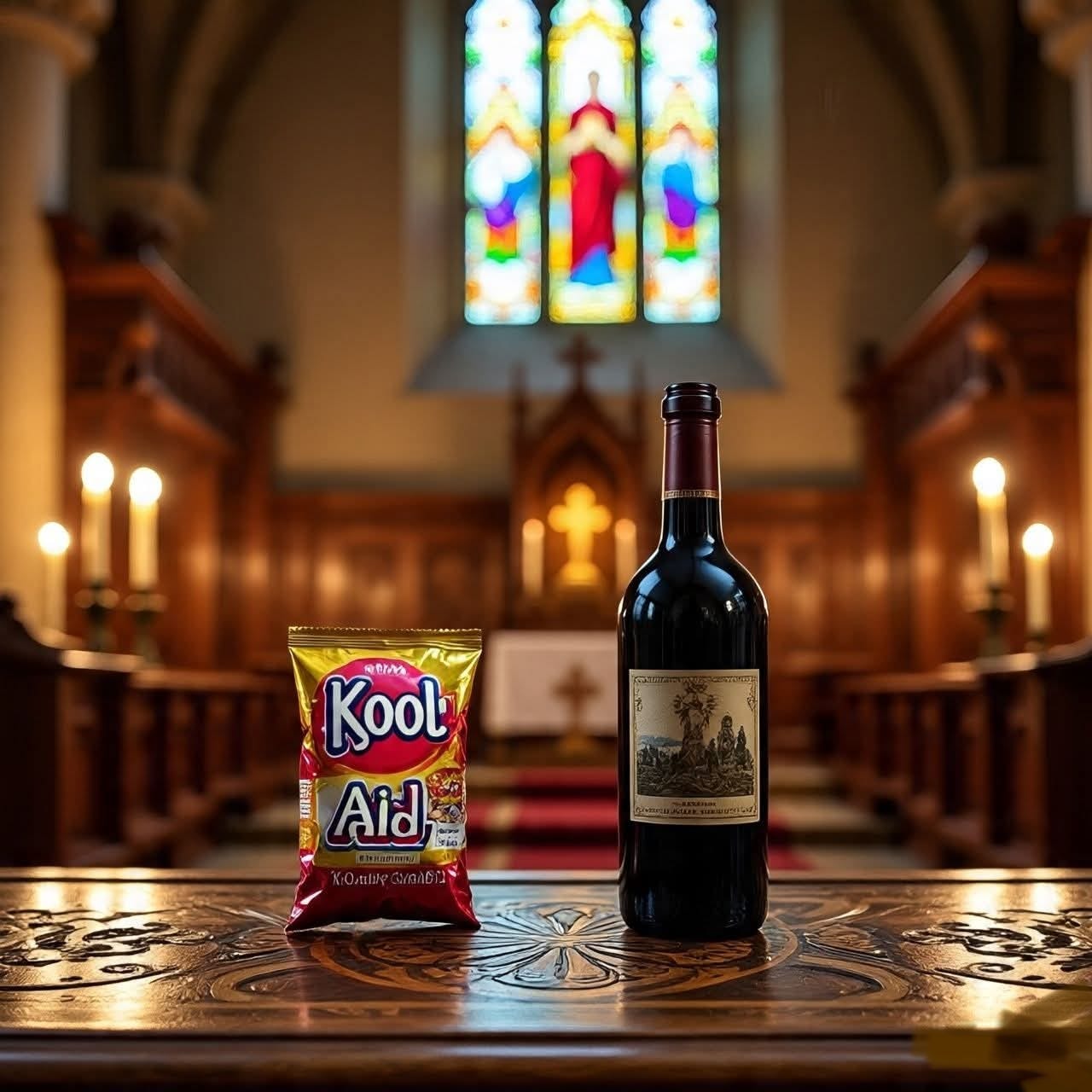
“It is a bit like the difference between Kool-Aid and a well-matured red wine,” said my beloved companion in her inimitable way as she struggled to articulate her first experience of a Solemn High Mass.
She did not mean it unkindly. In fact, there was a certain gentleness—even embarrassment—in her comparison, as though she feared it might sound irreverent. Yet it was precisely the sort of image that only someone untrained in polemics, but sensitive to reality, could produce. Kool-Aid and wine belong to entirely different worlds, not merely in taste but in origin, purpose, and depth. One is manufactured for immediacy: sweet, colorful, instantly gratifying, requiring no patience, no formation of the palate, no lingering reflection. The other is cultivated slowly, aged in silence, shaped by time, tradition, and restraint. To mistake one for the other is impossible once one has truly tasted both.
She had grown up, like many Catholics of her generation, knowing only the Novus Ordo Missae. It was familiar, intelligible, earnest, often well-meaning. She had encountered it in parish churches reordered for efficiency, accompanied by hymns she could sing after hearing them once, celebrated by priests who spoke directly, constantly, reassuringly. None of this struck her as scandalous; it was simply “Mass.” Yet when she found herself, almost accidentally, assisting at a Solemn High Mass of the traditional Roman Rite—with its chant, silence, ordered hierarchy of ministers, and overwhelming sense of gravity—she emerged visibly unsettled. Not angry, but quiet. Something had touched her, and she struggled to name it.
What she experienced was not simply a different aesthetic, nor merely a preference for Latin, incense, or vestments. She encountered a different conception of worship altogether. In the Solemn High Mass, nothing hurried to explain itself. The ritual assumed mystery rather than managing it. Meaning was not constantly verbalized but embodied—through gesture, orientation, and restraint. The priest did not address the congregation so much as lead it. The faithful were not entertained, instructed, or encouraged at every turn; they were placed, quite deliberately, before God.
This single remark—offered without agenda, without ideology—captures with disarming clarity the heart of the debate surrounding the Novus Ordo Missae. The controversy is often framed in terms of obedience versus preference, progress versus nostalgia, accessibility versus elitism. Yet these binaries obscure the deeper question: not whether one form of the Mass is valid, but whether all forms equally convey the fullness of what the Mass is. If the Mass is, as the Church teaches, the unbloody re-presentation of the Sacrifice of Calvary, the axis on which heaven and earth meet, then the manner in which this reality is expressed—ritually, theologically, symbolically—matters profoundly.
This series proceeds from that conviction. It does not argue from sentimentality or taste, but from substance. For the sake of those who are still asking what exactly is wrong with the new “Mass”, it seeks to examine, in a comprehensive and candid manner, the problems that theologians, priests, liturgists, and faithful Catholics have identified in the Novus Ordo Missae over the past half-century. The comparison between Kool-Aid and aged wine is a fitting diagnosis. And like all honest diagnoses, it demands that we look carefully—not away.
From Ritual Rupture to Spiritual Consequence
If the first wounds inflicted by the Novus Ordo Missae were theological and ritual, their deeper consequences unfolded slowly, almost imperceptibly, in the realms of culture, psychology, and belief. The reform did not merely change prayers and gestures; it subtly recast the inner posture of worship itself. What had once drawn the soul upward toward transcendence gradually trained it to remain at eye level. Mystery became explanation. Awe gave way to familiarity. Silence yielded to sound. In this way, the reform initiated not only a liturgical transformation, but an anthropological one.
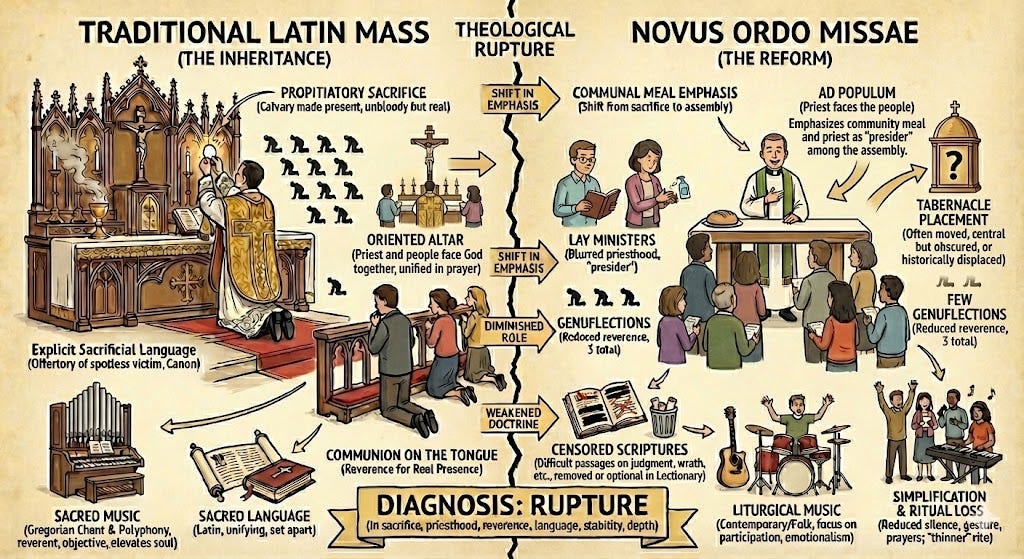
(Thanks to my subscriber Alyosha for this superb illustration he made:)
I. The Displacement of Mystery and Transcendence
The traditional Roman Rite did not explain itself; it enveloped. Its silences were not awkward gaps but sacred spaces, charged with expectancy. The quiet Canon, uttered in a near whisper, communicated by its very restraint that something fearful and holy was taking place. One did not observe the mystery; one knelt before it.
In the Novus Ordo Missae, this grammar of mystery largely evaporates. Nearly every prayer is spoken aloud. Microphones amplify what was once veiled. The Eucharistic Prayer becomes a narrated action rather than an enveloping event. Instead of silence indicating divine proximity, sound fills every crevice of the rite. Even when silence is prescribed, it is optional, brief, and often ignored.
This change is not trivial. Mystery cannot survive constant explanation. Transcendence withdraws when the sacred is relentlessly verbalized. The soul, denied the language of awe, slowly loses the instinct to adore.
II. The Collapse of Liturgical Boundaries
Closely connected to this loss of mystery is the collapse of clear liturgical boundaries. For centuries, Catholic worship carefully marked thresholds: between nave and sanctuary, clergy and laity, preparation and consecration, speech and silence. These boundaries were not expressions of clericalism but theological signposts, teaching that one was approaching holy ground.
In the reformed liturgy, these distinctions blur almost entirely. Lay “ministers” regularly enter the sanctuary. “Extraordinary ministers” cluster around the altar. The sanctuary itself is often architecturally indistinct, stripped of elevation, rails, or visual separation. What was once approached with trepidation is now accessed with ease.
The psychological effect is profound. When nothing signals “here begins the holy,” nothing trains the soul to kneel inwardly. Familiarity breeds not contempt, but indifference.
III. The Ritual Fragility of the New Liturgy
One of the most striking contrasts between the traditional Mass and the Novus Ordo lies in resilience. The ancient rite is almost indestructible. Its density of prayers, gestures, and silences creates a structure that resists intrusion. Personal creativity has little room to enter. The priest submits to the rite.
The Novus Ordo, by contrast, is remarkably fragile. Stripped of many ritual redundancies, it depends heavily on externals for tone and meaning. Music, celebrant personality, architectural setting, and pastoral style assume an outsized role. The result is that the character of the Mass is no longer intrinsic but contingent.
This fragility explains the extraordinary variety of modern Catholic worship. One encounters guitar-led Masses, heavily choreographed liturgies, conversational Eucharistic Prayers, applause, processions that resemble performances, and improvised commentary woven throughout the rite. These phenomena are symptoms of a rite that lacks sufficient internal gravity to hold itself together.
IV. Anthropocentrism and the Rise of Performance
As the rite loses transcendence, it inevitably acquires a new center: the human assembly. Language shifts from sacrifice to gathering, from oblation to participation, from offering to expression. The Mass becomes something the community does, rather than something Christ does through the priest.
This shift is reinforced by physical orientation. When the priest faces the people throughout the liturgy, he necessarily becomes a focal point. His mannerisms, tone, warmth, or awkwardness shape the experience. The pressure to engage, to be accessible, to personalize the rite grows intense. Over time, the priest becomes less a hidden instrument and more a visible facilitator and even an entertainer.
The danger here is not bad intentions, but structural temptation. A rite that requires constant eye contact invites performance. A rite that suppresses silence encourages verbal filling. A rite that prizes accessibility risks trivializing the sacred.
V. Calendrical Amnesia and the Loss of Sacred Time
Liturgical time is the Church’s memory. Through repeated seasons, fasts, vigils, and feasts, Catholics learned to inhabit sacred history. The pre-conciliar calendar formed the faithful gradually, returning year after year to the same moments, readings, and prayers until they became instinctive.
The post-conciliar reform disrupted this memory. Ancient seasons such as Septuagesima vanished overnight. Ember Days and Rogation Days disappeared from common practice. Octaves were abolished. The long pedagogical rhythm of repetition was replaced with constant variation.
The introduction of the three-year lectionary amplified this effect. While broader in scope, it fragmented coherence. The faithful no longer heard the same readings annually, nor did they encounter the same thematic unity between prayers and lessons. Memory weakened. Familiarity dissolved. The Mass became informational rather than formational.
A Church that forgets how to remember soon forgets who she is.
VI. The Doctrinal Thinning of the Lex Orandi
Because the Church teaches primarily through worship, changes in liturgical language inevitably shape belief. The reform did not explicitly deny Catholic doctrine, but it frequently softened, minimized, or omitted doctrinal emphases long present in the Roman Rite.
Prayers referencing judgment, penance, spiritual combat, and divine wrath were removed or reduced. Language of sacrifice was culled. References to merit, mortification, and the fear of God became rare. Marian invocations diminished in frequency and density.
What remained was not heresy but vagueness and ambiguity. Over time, vagueness breeds uncertainty. A generation formed by such language struggles to articulate clearly what the Church believes about sin, salvation, and sacrifice, because they no longer hear these truths embedded in prayer.
VII. Eucharistic Casualness and the Erosion of Belief
Perhaps no consequence of the reform is more visible than the dramatic weakening of Eucharistic reverence. Practices once universally forbidden or unknown became normal: Communion in the hand, standing reception, widespread use of extraordinary ministers, and the disappearance of fasting and confession as prerequisites.
Each change seemed small. Together, they created an atmosphere of remarkable casualness surrounding what Catholics profess to be the Body, Blood, Soul, and Divinity of Christ. The disappearance of the paten, the reduction of genuflections, the relocation of the tabernacle, and the multiplication of lay handlers all communicate, however unintentionally, that nothing particularly dangerous or holy is occurring.
Belief follows gesture. When gestures no longer proclaim mystery, belief quietly erodes.
VIII. Funerals Without Judgment and Hope Without Fear
Nowhere is the theological shift more apparent than in Catholic funerals. The traditional Requiem Mass confronted the faithful with death, judgment, and the urgency of prayer for the soul of the departed. Black vestments, suppressed Alleluias, and the chilling poetry of the Dies Irae formed Catholics in sober realism.
The reformed rites, by contrast, often avoid judgment entirely. Funerals are styled as celebrations of life. Eulogies dominate. White vestments replace black. Consolation eclipses supplication. The dead are implicitly canonized.
The doctrinal cost is severe. When judgment disappears from worship, repentance soon disappears from life.
The Church does not judge truth solely by statistics, but fruits matter. Since the introduction of the Novus Ordo Missae, the Western Church has experienced unprecedented collapse: Mass attendance plummeted, vocations declined, belief in the Real Presence cratered, catechetical knowledge evaporated, and religious practice disintegrated within a single generation.
Correlation does not automatically imply causation, but to deny any connection is intellectually dishonest. The most radical liturgical rupture in Catholic history coincided with the most dramatic spiritual collapse in Catholic history. This cannot be accidental.
A weakened lex orandi produces a weakened lex credendi. A weakened lex credendi produces a weakened Church.
Our Lady, Co-redemptrix, pray for us…
Our Lady, Mediatrix of all Graces, pray for us…
Viva Christo Rey!
Also Read:
“Christ is a Failed Individual” and Other New Blasphemies from the Synodal Dumpster Fire
Is This the Sanest Position for Faithful Catholics to Hold Regarding Post-Conciliar Popes?
Pope Claims Christians and Muslims Worship Same God at Interfaith Spectacle in Beirut
What do you suggest people do if all they have access to is NO masses in NO parishes?
What do you suggest people do when the Archbishop and Archdiocese where people live, is all about progressiveness and continuation of the most Catholic eroding aspects of Vat II? Such as ecumenism and synodality - yes, and the NO mass.
What can the Catholic faithful literally do when they see and understand what you outline in your writings yet there is no clergy to help “undo” the damage? Other than praying, and railing against other parishioners who prefer all the irreverances and dumbing down of faith, beliefs and practices, it feels at times as if we have been abandoned by clergy all the way up the Apostolic chain.
I had much the same experience at my first Latin Mass. Although it was an "indult" Mass, there was a marked difference in the demeanor of the congregation prior to Mass - no talking or laughing, no kids running around, jackets and ties for the men and boys, chapel veils and dresses for the women and girls, everyone who could was kneeling, and the Rosary was being prayed. After Mass my "girlfriend" at the time asked me what I thought. I told her there was no reason to go anyplace else for Mass. Although we broke up about a year later, I continued to attend the indult Mass, eventually converting (N.O. style) and graduating from the indult Mass to a Traditional Latin Mass offered through one of the Fraternal Societies. My journey in this period of increasing apostasy has been a blessing which I try not to take for granted.