

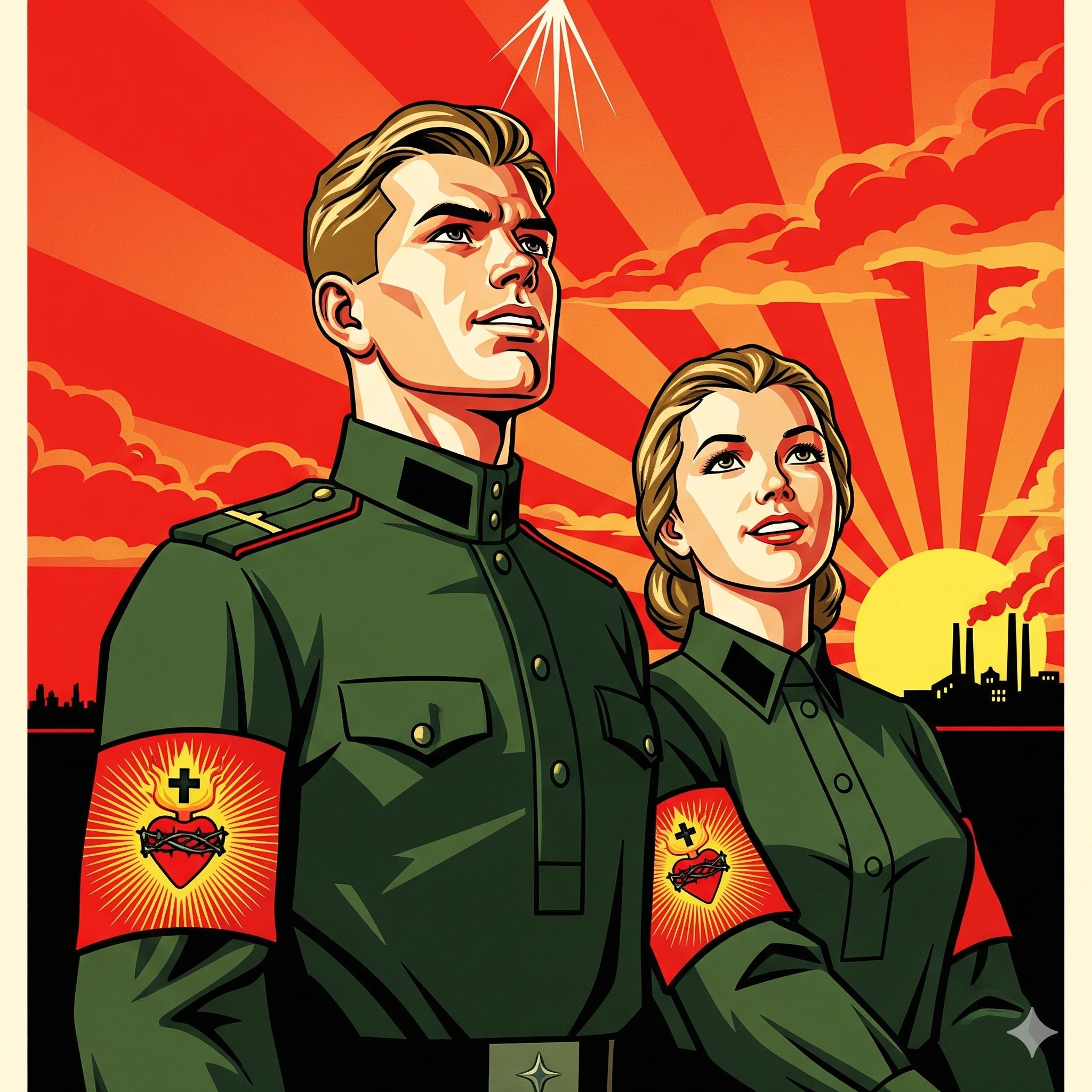
“If the Revolution is disorder, the Counter-Revolution is the restoration of order. And by order we mean the peace of Christ in the Reign of Christ, that is, Christian civilization, austere and hierarchical, fundamentally sacral, antiegalitarian, and antiliberal.” - Plinio Corrêa de Oliveira
The Revolution in the Church and in secular society has seemingly reached a fever pitch, and to the faithless observer it may appear to be a victory.
The Revolution’s fermenters are intoxicated by their rebellion against God, acting with impunity as they construct not some liberal utopia, but rather a kingdom resembling demonic barbarism. The examples are manifold: transgenderism and its accompanying mutilations, the elevation of infant-killing to a “right,” euthanasia in vogue, the normalization of paedophilia with bestiality not far behind, “smart cities” and technologies that are little more than totalitarian digital prisons, and—perhaps most grievous—a satanic, neo-pagan, neo-Protestant counterfeit of Catholicism being established within the very Church.
It is therefore of cardinal importance that the faithful recognize that a Catholicism of mere navel-gazing and pew-warming belongs to another age. Such attitudes must be consigned to the past. We must realize and internalize the truth that God created us for a time such as this. Each of us has been destined to stand and be counted now. The only Catholicism that will endure and turn the tide of Revolution is a 24-7-365, blood-and-guts Catholicism—steeped in tradition and firmly rooted in the majesty of Christ—not the popular, limp-wristed, hobbyist version.
It must be more than virtue signalling. It must be translated into righteous zeal—a zeal that seeks to understand the crisis in all its gravity and then lifts its eyes to heaven and prays to the Lord: “…teacheth my hands to fight, and my fingers to war” (Psalm 143:1, Douay-Rheims).
The history of Western civilization is no polite narrative of progress; it is a brutal, merciless battlefield. On one side stands the Revolution, an insidious, centuries-long campaign of rebellion against God, hierarchy, and order. On the other stands the counter-revolution, the only force capable of defending truth, virtue, and civilization itself. For Traditionalist Catholics, this is not a metaphorical struggle; it is a war for souls, a war to preserve the very foundation of Christendom. The Revolution does not merely seek reform or innovation—it seeks destruction. The eradication of divine and natural law, the substitution of authentic authority with secular egalitarian fantasies, and the corrosion of every moral and social bulwark that restrains chaos. The counter-revolution, in stark contrast, is militant fidelity. Fidelity to truth, to hierarchy, to tradition, and to God Himself, regardless of ridicule, persecution, or the apparent triumph of error.
Traditionalist Catholicism is the very essence of counter-revolution, the last and most determined bulwark against the systematic assault of the Revolution. This is not a nostalgic lament for a lost age but a call to arms, a declaration that the counter-revolution is not passive but active, combative, and unyielding.
In Traditionalist Catholic analysis, as defined by Plinio Corrêa de Oliveira and other Traditionalist thinkers, “revolution” is not a mere political event. It is a spiritual, cultural, and moral cancer, slowly metastasizing through society for centuries. It manifests in successive stages of corruption: the Protestant Reformation, which shattered Church unity and elevated private judgment above divine authority; the French Revolution, which dethroned Catholic monarchs, exalted secular egalitarianism, and reconstituted society as a playground of rationalist atheism; the Communist Revolution, which radicalized egalitarianism into murderous collectivism, abolishing property, faith, and freedom; and the Cultural Revolution of the modern era, which assaults the very foundations of human nature, redefining morality, sexuality, family, and identity. At the root of each stage lie pride and sensuality. Pride, the audacity to usurp God’s authority; sensuality, the rebellion against self-discipline and divine law. Together, they are the twin engines of societal decay, dissolving the order God established and exalting chaos, licentiousness, and false freedom.
Counter-revolution is not a timid reaction, nor a sentimental longing for vanished times. It is conscious, disciplined, and militant resistance. It seeks to restore hierarchy by recognizing God as supreme authority (the Kingship of Christ), the Church as His instrument, and society structured by natural law. It defends tradition by preserving the accumulated wisdom of centuries against the corrosive novelty of the Revolution. It reinforces moral discipline, promoting virtue and combating the decadence unleashed by revolutionary ideology. Counter-revolution is not mere opposition to change; it is the only true progress—the restoration of order, the exposure of falsehood as corruption, and the unwavering affirmation that fidelity to truth is humanity’s only path forward.
The Catholic Church has always been the Revolution’s primary obstacle. Consequently, the Revolution has sought from the start to corrupt, neutralize, or destroy it. In the modern era, this assault takes the form of modernism and progressivism. Modernism, reducing revelation to subjective experience and historical whim. Progressivism, emerging in the wake of Vatican II, seeks to bend the Church to the modern world, compromising dogma, desecrating liturgy, and pandering to secular permissiveness. It removes mystery and sacrifice from the Mass, relativizes the Church’s claim to be the one true Church, and warps moral teaching to align with the decadent ideals of contemporary culture. In effect, progressivism is the fourth stage of revolution within the Church itself, transforming Catholicism into a passive servant of worldly error.
Traditionalist Catholicism stands as a living counter-revolution against these forces. It battles external threats—liberalism, secularism, and Communism—while confronting internal challenges from modernism and progressivism. This counter-revolutionary stance encompasses multiple spheres: maintaining doctrinal fidelity to preserve divine truth's immutability; upholding liturgical continuity through the Tridentine Mass, which embodies hierarchy, mystery, and sacrificial worship; defending moral integrity against attacks on sexuality, family, and natural law; asserting proper authority and hierarchy against egalitarian ideology; and engaging in cultural militancy to protect property, family, and Christian civilization from sustained assault.
The counter-revolutionary spirit opposes revolution at every level, championing humility over pride, discipline over sensuality, tradition over novelty, and hierarchy over egalitarian chaos. For Traditionalist Catholics, this spirit transcends mere theory—it becomes a lived vocation, a daily and militant commitment to embodying order, virtue, and fidelity while confronting revolutionary corruption wherever it festers.
The obstacles are formidable. Traditionalists are marginalized, derided as backward, censored, and increasingly criminalized by a culture at war with God. Internal divisions threaten coherence, yet the counter-revolution endures, sustained by the certainty that truth can never be destroyed, only obscured.
The counter-revolution is incomplete because the Revolution is vast and deeply entrenched. Though victories have occurred—the Vendean resistance, the Cristero War, the survival of Catholic monarchies—these are temporary reprieves in a centuries-long war. The Revolution has infiltrated the Church, reshaped institutions, and poisoned culture. The counter-revolution must therefore be equally comprehensive, reforming souls, families, and societies in fidelity to Christ the King. It is not a momentary reaction, but a patient, militant campaign spanning generations.
Traditionalists understand that ultimate victory rests with God. The counter-revolution's current incompleteness reflects divine providence—it advances through human fidelity while awaiting divine intervention. Its foundation rests on three pillars: uncompromising defense of doctrine and liturgy; building Catholic strongholds in families, schools, and communities that embody Christian civilization; and maintaining confidence that each act of fidelity contributes to eventual restoration. Though incomplete, the counter-revolution remains unstoppable. This incompleteness represents mission, not failure—a vocation that belongs to every Traditionalist Catholic until Christ returns in glory to judge the nations.
Practical Militant Fidelity for the Counter-Revolutionary
It is tempting to conceive of the counter-revolution only in grand, sweeping strokes—armies, movements, monarchies, battles, or papal condemnations. Yet if the Revolution is total—if it infiltrates the parish, the family, the school, and even the conscience of the baptized—then the counter-revolution must likewise be total. It cannot remain an abstraction. It must be incarnated, lived, practiced daily by individual souls who refuse to conform to the world. The counter-revolution begins not with grand proclamations, but with a Catholic who decides that he will not bend the knee to error.
To live as a counter-revolutionary is to recognize that neutrality is impossible. The individual stands on a battlefield whether he wills it or not. The air he breathes is poisoned by liberalism; the streets he walks are paved by secular ideologies; the laws that govern him are saturated with atheism; and the very Church that should shield him is infiltrated by modernism. To live passively within such a regime is already to surrender. Thus the first practical step of the counter-revolutionary life is awareness: to recognize that existence itself has become a combat zone. Once that recognition is made, the Catholic is called to arm himself with spiritual weapons and to order his entire life around militant fidelity.
Prayer and Sacramental Life as Warfare
The first and most indispensable act of counter-revolution is the interior life. The Rosary is not a quaint devotion but a sword—as Our Lady herself declared at Fatima. Daily recitation of the Rosary, confession at least monthly (and more often if necessary), and the pursuit of daily Mass when possible, constitute the foundation of resistance. The Revolution thrives on spiritual amnesia. It severs man from God through distraction, noise, and indulgence. The counter-revolutionary resists by creating a rhythm of prayer that orders his day, sanctifies his time, and keeps him alert against temptation.
One must therefore reject the trivialized liturgies of the modernist establishment and cling to the Tridentine Mass or other traditional rites where reverence, hierarchy, and sacrifice remain intact. Attendance at the old Mass is not nostalgia—it is survival. In the sacred silence of Gregorian chant, in the eastward gaze of priest and people, the counter-revolutionary relearns what true order looks like: God above, man below, priest as mediator, the altar as the axis of the universe. To kneel at the traditional liturgy is to be re-trained in fidelity and hierarchy, even as the Revolution outside clamors for egalitarian chaos.
Family as Fortress
The Revolution knows that if it can corrupt the family, it has conquered society. Hence its relentless assault on marriage, sexuality, and the education of children. The counter-revolutionary therefore treats his household as a fortress of fidelity. The father must assume his role as head and protector, leading his family in prayer, defending purity, and governing with charity and firmness. The mother must sanctify the domestic sphere, cultivating a culture of order, beauty, and sacrifice. Together, parents must form their children in vigilance: not passive consumers of revolutionary poison, but soldiers of Christ who know their faith, love it, and can defend it.
This requires radical choices. Catholic families must often refuse public schooling where indoctrination is inevitable and must embrace homeschooling or trustworthy Catholic academies that reject modernist compromises. They must guard their homes against the infiltration of pornography, consumerism, and secular propaganda, for these are the weapons of the Revolution aimed directly at the innocence of their children. They must cultivate customs—the family rosary, Friday penance, feast-day celebrations—that weave Catholicism into the very fabric of daily life. The home must not be a pale reflection of the world, but its antithesis. A visible outpost of the counter-revolution, a small Christendom that withstands the battering of revolutionary storms.
Work and Vocation as Witness
The counter-revolutionary cannot confine his fidelity to the private sphere. His labor, his vocation, his public dealings—all must bear witness to truth. In the workplace, he refuses to mouth the slogans of diversity ideologues or bow before the idols of secular humanism. He will not lie to keep his position, nor celebrate perversion to keep his salary. He knows that compromise with error is treason, and that sometimes fidelity will cost him dearly—lost promotions, stalled careers, perhaps even dismissal. Yet this loss is victory, for to be counted unfit for a corrupt system is to be marked as loyal to Christ.
Those called to the priesthood or religious life bear an even heavier burden. Monks who maintain their ancient observances, nuns who live their vows of enclosure with integrity, priests who guard the Tridentine Mass and preach the full doctrine without mutilation—these are the officers of the counter-revolutionary army. Their fidelity strengthens the laity; their perseverance gives proof that tradition is not dead. Laymen and women, too, in their trades and professions, become soldiers by their refusal to bend. Every honest laborer, every uncompromising teacher, every principled businessman becomes a front-line fighter.
Culture, Aesthetics, and Daily Habits
The Revolution is not only doctrinal; it is cultural. It wages war through ugliness, vulgarity, and disorder. The counter-revolutionary therefore fights back even in the small details of life. He rejects fashions that glorify immodesty, speech that echoes filth, and entertainment that exalts sin. He surrounds himself with beauty—sacred art, noble music, literature that uplifts rather than degrades. His home becomes an enclave of Catholic culture where sacred images replace modernist abstractions, hymns replace pop noise, and conversation replaces mindless distraction.
He understands that aesthetics is not neutral. The banal liturgy produces banal faith; the ugly city produces ugly souls. Thus, he cultivates courtesy, dignity, and discipline in manners. He is not swayed by the sneer that these things are “old-fashioned.” He knows they are weapons. Small but potent acts of resistance that silently proclaim the truth of order against the chaos of egalitarian vulgarity.
Militancy in the Public Sphere
The counter-revolutionary cannot vanish into the shadows. Even if outnumbered, he must enter the public square. He supports traditionalist schools, apostolates, and publications. He protests the desecration of life, the profanation of marriage, the blasphemies committed in the name of “art.” He refuses to use the pronouns of delusion or the language of revolutionary lies, even if the price is social exile or legal penalty. Silence in the face of evil is complicity; therefore, he speaks—even if only one voice is raised against the howling mob.
He is not deceived into thinking politics alone can restore Christendom. The ballot box is not the throne of Christ the King. Yet he knows that public witness, however small, prevents the Revolution from claiming total victory. To refuse, to resist, to contradict, even at cost—this is his form of combat. He carries the certainty that truth is not measured by numbers, and fidelity is not measured by worldly success.
Discipline and Asceticism
The Revolution thrives on indulgence. It enslaves men to gluttony, lust, and sloth, then mocks them as powerless. The counter-revolutionary answers with asceticism. He fasts on Fridays, mortifies his senses, curbs his appetites, and master’s his passions. He avoids the snares of pornography, drunkenness, and luxury. He embraces penance, for he knows that without self-mastery there is no resistance.
Discipline is his weapon. It keeps him vigilant where others are dulled, free where others are enslaved. His joy comes not from indulgence but from order—the peace that follows mastery. The revolutionary chases pleasure and ends in despair; the counter-revolutionary embraces sacrifice and finds freedom. His body, his soul, his time, his speech—all are brought under the dominion of Christ.
Perseverance Amid Isolation
To live this way is to be mocked, excluded, even hated. Families will be called extremists; priests will be punished by their bishops; young Catholics will be ridiculed by their peers. Yet the counter-revolutionary accepts isolation as the price of fidelity. He does not crave applause but endures with patience, knowing that he fights not alone but with the communion of saints.
History testifies to this paradox. The Vendeans slaughtered in their fields, the Cristeros hanged in silence, the priests who whispered Mass in hidden rooms—these seemed to fail. But fidelity is never failure. Their blood watered the seeds of future resistance. So too today: every counter-revolutionary act, even if unseen, even if scorned, contributes to the final triumph.
Confidence in Victory
Finally, the counter-revolutionary lives with indomitable hope. He surveys a world drowning in apostasy and knows that humanly speaking, the Revolution is entrenched, powerful, and seemingly invincible. But he also knows the promise of Our Lady: “In the end, my Immaculate Heart will triumph.” He fights not in despair but in confidence. His task is fidelity. The victory belongs to God.
This hope transforms his combat. He does not fight with bitterness, but with supernatural courage. He is militant yet serene, unyielding yet peaceful, because he knows the outcome. His life, small as it may seem, is woven into the tapestry of providence. Every Rosary prayed, every temptation resisted, every child formed in truth, every Mass attended in reverence—all are bricks in the edifice of the restored Christendom.
The individual counter-revolutionary, then, is not an anonymous bystander in history but a soldier in the only war that matters. He may never see the victory with his own eyes, but he lives and dies confident that fidelity itself is triumph.
Deus Vult!
Viva Christo Rey!
ALSO READ:
Now Aren’t You the Hypocrite, Archbishop?
The Modernist Gospel of Comfort is Leading You to Hell
Bishop Profanes the Altar of God at Saltillo Shrine of Our Lady of Guadalupe
Offensive Mass Bible Readings to be “Updated” for Inclusivity in at Least Three Countries
The Gospel According to Aleister Crowley is Alive and Well in Modern Catholicism
African Bishop's Comments Prove 'Mainstream' Catholicism is Rotten Everywhere
This is a strong call to arms, and I agree that lukewarm Catholicism cannot withstand the tide of the Revolution. At the same time, I wonder if the true counter-revolution is less about meeting force with force and more about what St. Paul calls us to be faithful under weight in (Gal 6:2). The deepest healing comes not only through militancy but through presence—through Catholics who, in silence and fidelity, reflect Christ even in their own weakness.
The Church is indeed wounded, but perhaps the way we shine into those wounds is not only by denouncing corruption, but by living the Beatitudes in the midst of it: humility, mercy, purity, patience. To kneel before the Eucharist, to confess often, to endure trial with fidelity—these are not passive gestures. They are the hidden fire by which the Lord renews His Body. Even our flaws, surrendered to Christ, can become a testimony that draws others back, because His strength is made perfect in weakness (2 Cor 12:9).
The counter-revolution, then, is not only about resisting error, but about letting our very lives become small lamps that is shining the light of Christ quietly and steadfastly into the dark places, until His victory is revealed. With this in mind I would like to invite people to read these two articles.
https://concordiancatholicspirituality.substack.com/p/the-way-of-concordian-catholicism
https://concordiancatholicspirituality.substack.com/p/psalm-1-the-gateway-to-the-psalms
Thank you. The strategy you lay out is very profound and practical.