
Another “Theologian” Attacks the Blessed Virgin Mary
This garbage seeps into our seminaries, our parishes, into sermons, and most tragically into the minds and hearts of our young woman and destroys their God-ordained destinies.

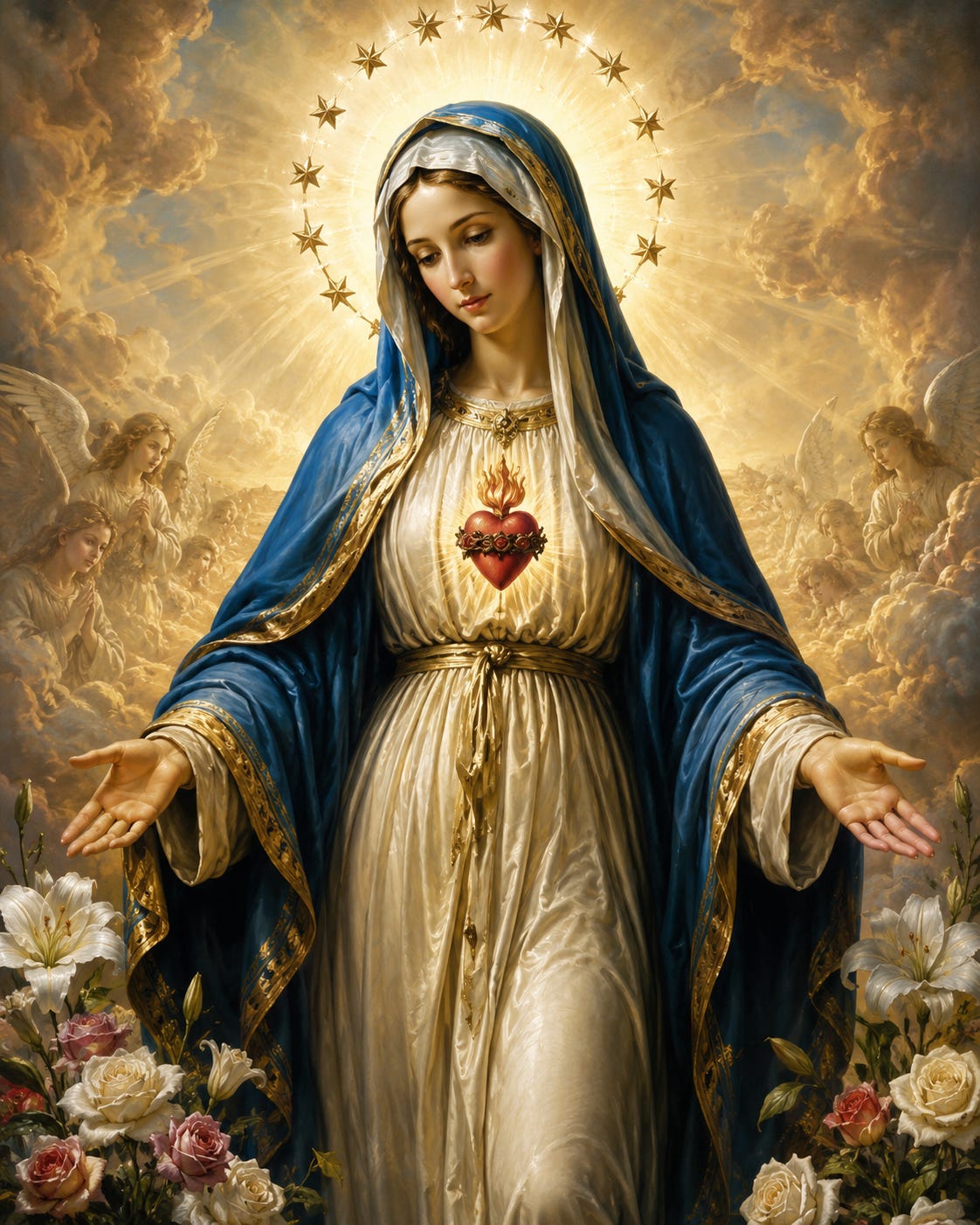
The recent comments of German theologian Annette Jantzen in an interview with Kirche und Leben continue a growing trend in modern theology as found in the Synodal Church and its adjacent structures: a relentless war on the Mother of God.
Jantzen, who in the good old days would have been burnt as a witch, ticks all the boxes that constitute the synodal religion’s rebellion against God’s Church. She recasts ancient dogmas as symbolic narratives, treats Marian devotion with blasphemous suspicion, and softens the supernatural character of the Gospel into metaphor.
Jantzen argues that Marian devotion becomes dangerous when Mary is presented as “virginal, sinless, and mother,” claiming such beliefs create “unrealistic standards” for women. This “theologian,” and might I add enemy of true womanhood, seemingly does not know, or denies, the fact that these qualities are not later theological inventions imposed upon Christianity, but part of the deposit of faith of the religion she claims to represent.
The perpetual virginity of Mary was defended by the Fathers of the Church from the earliest centuries, her divine motherhood was solemnly proclaimed at the Council of Ephesus in 431, and her Immaculate Conception was defined by Pope Pius IX in Ineffabilis Deus in 1854, though belief in her unique holiness long predated the formal definition. Catholics do not honor Mary because she conforms to modern expectations of femininity (or should we rather say feminism), but because God Himself chose and sanctified her for a singular role in salvation history.
The Gospel of Luke plainly states that the angel Gabriel announced to Mary: “The Holy Ghost shall come upon thee” and “therefore also the Holy which shall be born of thee shall be called the Son of God.” According to Catholic teaching, this was a real and miraculous virgin conception, not merely a literary symbol. Jantzen reduces the beautiful and glorious virgin birth to a common ancient narrative motif, which empties the Incarnation of its supernatural reality.
Christianity is not founded upon symbolic myths detached from history. Saint Paul himself wrote that if Christ be not truly raised from the dead, our faith is vain. The Creed is a proclamation of events that actually occurred in time and space. With her arrogant questioning of Catholic truth, Jantzen plays right into one of the devil’s oldest and most effective strategies: if the virgin birth is only symbolic language, then the believer is left wondering which parts of the Gospel remain historical at all. As a theologian, one would expect her to bring clarity rather than confusion, but in the end, we are dealing with a rabid feminazi.
Jantzen also warns against taking symbolic language “literally,” despite the fact that Catholic theology has never been guilty of simplistic literalism. The Church recognizes multiple senses of Scripture, including allegorical and spiritual meanings, while at the same time insisting that the central mysteries of salvation are real events. The virginal conception of Christ is not a poetic metaphor for the synodal obsession with human dignity, but a miracle that was worked by God.
Her criticism of Marian devotion also undermines the purpose of Catholic veneration. Mary is not proposed as an impossible rival to ordinary women, but presented as the highest example of what grace can accomplish in a human soul. Catholics do not look to Mary merely as a sociological model, but as the New Eve, the Mother of God, and the greatest of the saints.
Ironically, modern theologians like Jantzen often accuse Marian doctrine of diminishing women, when in fact the Church’s exaltation of Mary radically elevated the dignity of womanhood in Christian civilization. Pagan antiquity frequently viewed women as disposable or inferior until Christianity came along and proclaimed that a woman freely cooperated in the redemption of the world. The Blessed Virgin was crowned Queen of Heaven not because of political power or worldly achievement, but because of holiness.
Shockingly, Jantzen suggests that Marian ideals can pressure women because they “ignore the realities of life,” but in reality, Catholic spirituality has never taught that every woman must slavishly imitate Mary in identical ways. Virginity, marriage, and motherhood are all honored within Catholic tradition. The saints themselves reveal enormous variety. Saint Joan of Arc was a warrior, Saint Gianna Molla was a physician and mother, and Saint Thérèse of Lisieux lived hidden in a cloister, to mention but a few.
Moreover, Marian devotion has always been, and still is, a source of comfort and strength for ordinary Catholics, especially women enduring suffering. Countless mothers, widows, religious sisters, and poor laborers have turned to Our Lady not because she oppressed them, but because she understood sorrow. The image of the Pietà, with Mary holding the dead Christ, speaks to human suffering more profoundly than modern ideological critiques ever could. Although Jantzen acknowledges that Marian devotion can offer “closeness, intimacy, and security,” she is unwilling to accept the doctrinal foundations that make such devotion meaningful in the first place. A merely symbolic Mary cannot truly intercede for the faithful or reveal the divine intervention of God in history.
Another heretical aspect of Jantzen’s theology is its tendency to reinterpret doctrine through contemporary ideological concerns. Her broader body of work frequently emphasizes “gender-fair” language for God and critiques what she sees as patriarchal structures within biblical interpretation. She is a vocal advocate in the synodal/ modernist campaign for modern political categories to become the lens through which revelation itself must be judged.
If Jantzen was a God-fearing Catholic theologian, she would know and celebrate the fact that Marian doctrine ultimately protects Christology. The title “Mother of God” safeguards the truth that Jesus Christ is one divine Person, while the virgin birth testifies that Christ’s origin is divine. Mary’s sinlessness points toward the holiness of the Incarnation itself. Once Marian doctrines are weakened and ultimately destroyed, which is the aim of theologians like Jantzen and “prelates” like “Cardinal” Victor Fernandez, the doctrines concerning Christ will soon follow. That, we know, is their endgame.
The solution to distorted understandings of womanhood is not to diminish Mary, but to understand her correctly and to return to traditional Catholic teachings about womanhood and the roles of women. Mary is many beautiful things women can imitate: humble yet courageous, obedient yet strong, contemplative yet active in charity. She is not a weapon in the filthy ideological battles of feminism, but the masterpiece of divine grace.
At Fatima, Lourdes, Guadalupe, and countless shrines throughout Christian history, devotion to Our Lady has brought conversions, repentance, vocations, and miracles. The Rosary has strengthened martyrs, missionaries, and families through centuries of persecution and war. Faithful Catholics know from experience that authentic Marian devotion does not enslave souls but leads them to Christ.
As Saint Louis de Montfort famously wrote, “To Jesus through Mary.” That remains the heart of true Marian theology, yesterday, today, and forever.
I want to conclude by explaining why I even give her, and other enemies of Christ like her, any attention. It is important to note that Annette Jantzen is not an outside critic of Catholicism from one of the Protestant sects, but a theologian who identifies herself as Catholic and works within official Catholic structures in Germany. She studied Catholic theology at several prominent universities, including Bonn, Jerusalem, Tübingen, and Strasbourg, and has served in pastoral and theological roles connected to the Diocese of Aachen. Her work is regularly featured in Catholic publications and media outlets across the German-speaking world. At the same time, her theological positions reflect the influence of modern progressive and feminist theology, particularly in her approach to Scripture, Marian devotion, gender language, and the interpretation of miracles. While she presents herself as operating within the Catholic tradition, her views are incompatible with the Church’s historic teaching on the Blessed Virgin Mary and the supernatural character of the Gospel accounts.
Safe to say she is therefore a heretic and should be treated as such. But not only that. Sadly, the garbage she promotes in the name of Catholicism seeps into our seminaries, our parishes, into sermons, and most tragically into the minds and hearts of our young woman and destroys their God-ordained destinies.
Our Lady, Co-redemptrix, pray for us…
Our Lady, Mediatrix of all Graces, pray for us…
Viva Christo Rey!
ALSO READ:
The Most Insidious False Virtue of the Antichrist Religion
Latest Synodal Report Cunningly Sneaks in Attempt to Normalize Perversion
Transalpine Redemptorists Say the Not-so-quiet Part Out Very loud
Leo XIV’s Communist Petticoat Hangs Out in New Book
Faithful Polish Catholics Outraged Over Betrayal of Christ in Bishops’ Heretical Letter
Can anything good come from Germany post Vatican II?
Vomit worthy. Sadly, she's far from alone. Utterly diabolical, of course.