

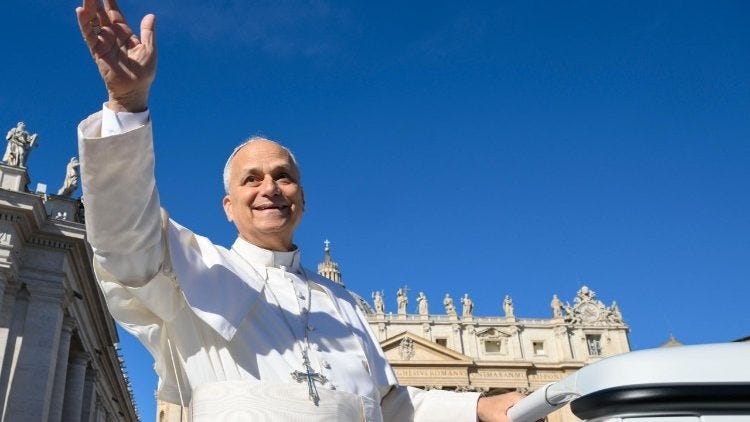
Pope Leo XIV’s first Apostolic Exhortation, Dilexi te (“I have loved you”), was thrust upon the world earlier today.
What can I say? I read it. It was about the poor. I had a headache. It was hardly inspiring.
It was also presented as the “completion” of an unfinished document by his predecessor. (The unintended symbolism of this is staggering: Leo is here to finish what Francis started.)
It arrived clothed in the familiar language of mercy, urging the Church to rediscover her love for the poor. It quotes Scripture, the Fathers, and the saints with reverence, insisting that holiness without charity is a contradiction. No Catholic can dispute that. Yet beneath the fragrance of Gospel citations lies a troubling — though unsurprising — vagueness: the familiar haze of post-conciliar rhetoric, where zeal for the poor drifts unmoored from doctrinal clarity.
The exhortation speaks eloquently of “structures” and “systems” that demand conversion, yet never defines them. It condemns “injustice” but refuses to say who or what is unjust. The result is moral poetry rather than moral theology. By avoiding precision, the text invites readers to baptize whatever ideology presently parades as compassion. It also reads as though the Pope asked someone at the UN to write it — who then tasked AI to finish the job.
The phrase “preferential option for the poor” recurs like a mantra — noble in origin, but here inflated into a slogan ripe for political misuse.
More troubling still is the document’s horizontal tone. Its pages overflow with activism, “accompaniment,” and “solidarity,” yet the supernatural order — grace, sin, sacrifice, the Cross — flickers only at the margins. Charity is treated as social reform rather than sanctifying love. Where are the sacraments? Where is the altar, the confessional, the Eucharist that alone can transform the heart? When these things are mentioned, they appear as though they exist only to serve one goal: the alleviation of world poverty. Thus the Church becomes a social agency with incense, rather than the Mystical Body of Christ ordered toward salvation.
The document also misses the opportunity to show that our efforts to help the poor should ultimately serve as occasions to evangelize them — to bring non-Catholics into the Church and convert them to the faith.
When the exhortation does speak about sin, it speaks without defining sin itself. Reparation and penance are not mentioned at all. The result is a Christianity reduced to a sentiment of moral activism — something that feels holy because it feels kind.
The tragedy of such documents is their desire to be both ancient and fashionable. They quote Chrysostom, then speak like an NGO. They affirm continuity, then write as though continuity were an embarrassment.
Ultimately, Dilexi te does not present the social reign of Christ the King as the solution to the poor’s temporal and eternal problems. Instead, it attempts to present the Church as a partner and friend of the world — a benevolent organization striving to build a utopia on earth.
Yet the poor do not need another manifesto; they need saints. The world will not be redeemed by better policies but by better priests, better families, and better confessions. Until the Church remembers that, her eloquent calls to love will echo like cymbals — loud, shining, and empty.
You can read the document yourself. But unless you are some moral amputee who didn’t know that caring for the poor is an essential part of the Gospel, it is hardly worth your time.
I do want to pause though at something the Pope brings up twice — once through his own “musings” and once by quoting Francis.
In paragraph 23, Pope Leo writes:
“I often wonder, even though the teaching of Sacred Scripture is so clear about the poor, why many people continue to think that they can safely disregard the poor…”
And in paragraph 31, he says, partially quoting Francis:
“The message of God’s word is so “clear and direct, so simple and eloquent, that no ecclesial interpretation has the right to relativize it. The Church’s reflection on these texts ought not to obscure or weaken their force, but urge us to accept their exhortations with courage and zeal. Why complicate something so simple? Conceptual tools exist to heighten contact with the realities they seek to explain, not to distance us from them…”
Read these two statements again and let them sink in:
“I often wonder, even though the teaching of Sacred Scripture is so clear about…, why many people continue to think that they can safely disregard…”
and
“The message of God’s word is so clear and direct, so simple and eloquent, that no ecclesial interpretation has the right to relativize it…”
Oh, the delicious irony!
Yes, dear Pope Leo, we have a very similar questions to ask — based on precisely this principle.
If Scripture is indeed “so clear and direct, so simple and eloquent,” and the Church has no right to relativize it, then why doesn’t the post-conciliar Church understand these verses:
John 14:6 — “Jesus saith to him: I am the way, and the truth, and the life. No man cometh to the Father, but by me.”
Acts 4:10–12 — “Be it known to you all, and to all the people of Israel, that by the name of our Lord Jesus Christ of Nazareth, whom you crucified, whom God hath raised from the dead, even by him this man standeth here before you whole. This is the stone which was rejected by you the builders, which is become the head of the corner. Neither is there salvation in any other. For there is no other name under heaven given to men, whereby we must be saved.”
1 Timothy 2:5–6 — “For there is one God, and one mediator of God and men, the man Christ Jesus: Who gave himself a redemption for all, a testimony in due times.”
Psalm 95 (96):5 — “For all the gods of the Gentiles are devils: but the Lord made the heavens.”
Leviticus 18:22 — “Thou shalt not lie with mankind as with womankind, because it is an abomination.”
Leviticus 20:13 — “If any one lie with a man as with a woman, both have committed an abomination.”
Genesis 1:27–28 — “And God created man to his own image: to the image of God he created him: male and female he created them. And God blessed them, saying: Increase and multiply…”
Matthew 19:4–6 — “Have ye not read, that he who made man from the beginning made them male and female? And he said: For this cause shall a man leave father and mother, and shall cleave to his wife, and they two shall be in one flesh. Therefore now they are not two, but one flesh. What therefore God hath joined together, let no man put asunder.”
James 4:4 — “Adulterers, know you not that the friendship of this world is the enemy of God? Whosoever therefore will be a friend of this world becometh an enemy of God.”
Romans 12:2 — “And be not conformed to this world; but be reformed in the newness of your mind, that you may prove what is the good, and acceptable, and perfect will of God.”
Acts 5:29 — “But Peter and the apostles answering, said: We ought to obey God rather than men.”
Dear Pope Leo, these are only a handful of the verses from Sacred Scripture that are “so clear and direct, so simple and eloquent, that no ecclesial interpretation has the right to relativize them.” The Church’s reflection on these texts, as you say, “ought not to obscure or weaken their force, but urge us to accept their exhortations with courage and zeal.”
I could share many more with the hierarchy, but I will conclude with a favorite:
1 John 2:18–22 — “Little children, it is the last hour; and as you have heard that Antichrist cometh, even now there are become many Antichrists: whereby we know that it is the last hour. They went out from us, but they were not of us. For if they had been of us, they would no doubt have remained with us; but that they may be manifest, that they are not all of us. But you have the unction from the Holy One, and know all things. I have not written to you as to them that know not the truth, but as to them that know it: and that no lie is of the truth. Who is a liar, but he who denieth that Jesus is the Christ? This is Antichrist, who denieth the Father and the Son.”
Just sayin’.
Christus vincit!
Christus regnat!
Christus imperat!
Also Read:
Responding to the Latest Attack on Traditional Catholicism from Where Peter is
More Fruit from a Church in Full Pagan Mode
Sadly, Traditional Catholicism Means Nothing...
Pope Defends Award to Pro-Abortion Senator (and Promotes Religious Indifferentism in Prayer)
Pope’s Latest Comments Reveal Secularism Masquerading as Catholic Wisdom
Was This the Primary Cause of the Abominable Failures of Vatican II?
I could only bring myself to scan this bloated, ambiguous papal document. Language about "migrants" (73) is devoid of any reference to their obligation to respect immigration laws. Where is any specific admonition of leaders of failed nations to improve conditions? Where is the warning about globalists using non-Christian migrants to destroy vestiges of Christendom? Leo also sneaks in a jab at traditional Catholics: "The defenders of orthodoxy are sometimes accused of passivity, indulgence, or culpable complicity regarding the intolerable situations of injustice and the political regimes which prolong them." Who can doubt he is referring to those of us who want secure borders and highly regulated immigration?
I cannot read any more synodal gibberish from the ape of the church in Rome and its devotees. We all know that "the familiar haze of post-conciliar rhetoric" is nothing more nor less than modernism dressed up in doublespeak specifically designed to be vague, ambiguous, and confusing.
Thank God there is at least one Church that is still completely faithful to the Traditional Magisterium as it existed prior to the abomination of desolation now in Rome. For us, that Church is CMRI. Others may see it differently though I do not judge them, only pray for them that they too may see the Light of Truth.
De profundis ad te clamavi Domine; Domine, exaudi vocem meam.