

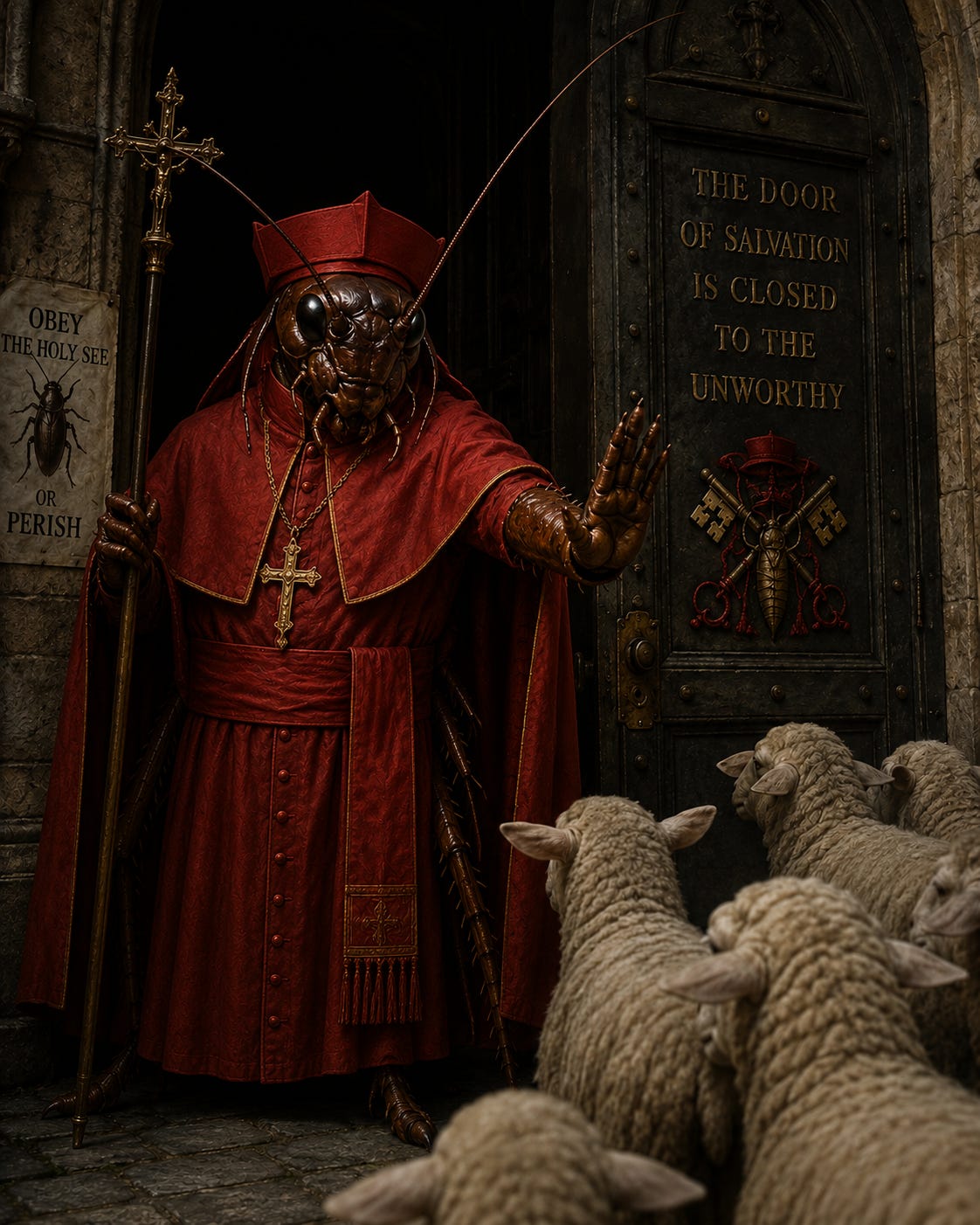
In the past 48 hours, every synodal-adhering cockroach who secretly (and not-so-secretly) hates Catholicism has crawled out of the spiritual darkness in which it usually nests to condemn the most mainstream and visible expression of Catholicism that its heresy-addled little mind can recognize: the SSPX.
This comes, of course, in the wake of the consecrations and the excommunications that everyone expected. What many in the SSPX did not see coming, and what many in the Novus Ordo camp were praying for, was the excommunication of laity who “formally adhere” to the SSPX.
By the way, don’t get tripped up by the semantics. I will translate: the excommunication and invalidation of the SSPX’s sacraments of marriage and confession are a way of not only getting rid of the SSPX, but also the last remaining community of faithful Catholics in the Synodal Church. The sedevacantists left a long time ago to go and practice Catholicism. But those stubborn little SSPXers had to be gotten rid of, and this was their chance.
So, if you are one of the SSPX faithful, let me be one of the first to congratulate you:
You, my dear friend, have finally been “excommunicated” from the false Synodal Church and a whole succession of charlatan popes. You are, according to them, officially no longer a member of their satanic, sodomy-promoting antichrist institution. (It is not a church; there is only one Church: the Roman Catholic Church.)
Yes, as they say in the movies: the jig is up.
You can now breathe. Savor the moment. No longer do you have to jump through hoops and bend your brain out of shape trying to reconcile their faggoty demon religion with Catholicism.
No longer do you have to live in a state of cataclysmic dysphoria and terminal cognitive dissonance because “things just don’t add up.”
No longer do you have to be part of a Catholic-hating, Christ-hating, schismatic sect that has been grieving Our Lord and Our Lady with its claims that all religions and all sects will inherit the Beatific Vision.
Not only that, but you are now officially part of one of the noblest clubs in salvation history: the Matthew 5:11 Club:
“Blessed are ye when they shall revile you, and persecute you, and speak all that is evil against you, untruly, for my sake: Be glad and rejoice, for your reward is very great in heaven. For so they persecuted the prophets that were before you.”
(Okay, I know. That is Matthew 5:11 and 12.)
Be assured: your “membership” in this club is going to be confirmed intensively going forward. You will be called a Protestant, “not Catholic,” a schismatic, and a heretic. Don’t worry; it is all part of the honour of being a real Christ-honouring Catholic.
But I know we all have different temperaments and are at different places in this journey of defending the rights of God and His Church, so this is the part I really want to get to.
You might have heard me say often, and you will hear it even more now, that “heretics can’t excommunicate Catholics.” Today, and giving him full credit, I will stand on the shoulders of one of the soberest voices in Traditional Catholicism, SD Wright, to help ease the anxiety of those who are worried about the “excommunication.”
I want to give Sean full credit, as I am greatly indebted to him for borrowing heavily from one of his articles. I strongly encourage my readers to subscribe to WM Review and to read the original brilliant article HERE.
So, let’s dive in.
The Catholic (not modernist synodal garbage) understanding of excommunication has always been that it is an act of ecclesiastical authority exercised by the Church through those who lawfully possess jurisdiction.
For this reason, the Church’s canonists and theologians taught that a heretic cannot excommunicate another person because he cannot exercise an authority that he himself no longer possesses.
This principle is expressed clearly in the Decretum Gratiani, Causa XXIV, Question I, Canon IV, known by its opening words Audivimus. There, Gratian quotes a letter of Pope Alexander II concerning Henry, Archbishop of Ravenna, who attempted to excommunicate others while he himself was under excommunication. Pope Alexander declared, “Being excommunicated, he could not excommunicate you,” and ordered those affected by his sentence not to trouble themselves about it.
Gratian immediately explains that the canon applies especially to those excommunicated for heresy. He writes that if a bishop “fabricated a new heresy from his own heart, from the moment he began to preach such things, he could condemn no one, because one who is already prostrate cannot cast down another.” The loss of authority does not arise only after a formal condemnation by the Church, but from the moment the person publicly separates himself from the faith by preaching heresy.
Gratian goes on to explain why this is so. The power of binding and loosing was given by Christ to true priests within the unity of the Church and through the power of the Holy Ghost. Those outside the Church (i.e., the schismatic, heretical synodal religion and its popes and hierarchy), whether through heresy, schism, or excommunication, cannot bind or loose, cannot reconcile, and cannot deprive others of ecclesiastical communion because they themselves lack that communion. As Gratian states, those outside the Church “can neither bind nor loose, nor restore to ecclesiastical communion by reconciliation, nor deprive of that fellowship by excommunication.”
The same principle appears later in Causa XXIV, Question I, Canon XXXI, where a text attributed to St. Cyprian declares: “We say that absolutely all heretics and schismatics possess nothing of power or right.” Canon XXXV cites Pope Celestine’s ruling concerning the followers of Nestorius, stating that if anyone had been excommunicated or deprived of office by Nestorius after he began preaching heresy, that person remained in communion with the Church because “the sentence of one who had already shown himself deserving of removal could not remove anyone.”
Canon XXXVI repeats the principle even more explicitly. Pope Celestine taught that no bishop, cleric, or Christian cast out of communion by Nestorius or his followers after they began preaching error was to be regarded as excommunicated at all because “one who wavered in preaching such things could not cast down or remove anyone.” The canon concludes by asking rhetorically how those who had already removed themselves from the Church could possibly remove anyone else.
These texts became important authorities in later Catholic theology and canon law. They were cited to demonstrate that ecclesiastical authority depends upon communion with the Church and adherence to the Catholic faith. A heretic cannot deprive another person of membership in a body from which he himself has already separated.
An important qualification must be added. The argument that a person cannot excommunicate because he lacks ecclesiastical authority depends entirely upon the prior recognition that the person issuing the sentence is, in fact, a heretic or has otherwise separated himself from the Church.
The conclusion follows from the premise. If one recognizes a bishop or pope as a true Catholic superior possessing jurisdiction in the Church, then one must also recognize his power to bind and loose, including the power to excommunicate, even if one believes a particular sentence to be mistaken or unjust. So, if you continue to validate Leo XIV, then merely saying the excommunication “isn’t fair” doesn’t cut it. You need to recognize the heretical status of the synodal church and its popes. Sorry, but you can no longer have it both ways.
The authorities collected in Causa XXIV, Question I of the Decretum Gratiani apply precisely because the persons in question, such as Nestorius and his followers, were understood to have departed from the Catholic faith and therefore to have forfeited the authority they attempted to exercise. As Wright’s article itself observes, the conclusion that a figure such as Leo XIV has no power to excommunicate rests upon the prior recognition that he is a heretic and therefore not the superior of any Catholic. If one does not accept that premise, the argument cannot be consistently applied.
This principle was distinguished from the case of an unjust excommunication imposed by a lawful Catholic superior. Pope Pius IX condemned the Jansenist claim that an excommunication issued by a lawful prelate could simply be ignored because it was believed to be unjust. The issue in the case of heretics is entirely different. The question is not whether the sentence is fair or unfair, but whether the person issuing it possesses authority to issue it at all.
For this reason, the traditional canonical maxim remained that those excommunicated by heretics are not to be considered excommunicated because excommunication is an act of the Church’s authority, and one who has separated himself from the faith and unity of the Church cannot exercise an authority that belongs only to the Church herself.
This essay was already completed when more absurd news broke. The Vatican’s Dicastery for the Doctrine of the Faith has issued guidelines for members of the Society of Saint Pius X (SSPX) seeking to return to full communion with the Synodal Church following the Society’s excommunications over unauthorized episcopal consecrations.
SSPX clergy wishing to reconcile are required to seek acceptance from a Synodal authority, request the lifting of canonical penalties from the “Pope”, and affirm a profession of faith and adherence to Synodal Church teaching.
Lay members closely associated with the SSPX and its doctrinal positions must also formally accept Synodal teachings, including the authority of the Synodal Church’s Magisterium, the reforms of the demonic Second Vatican Council, and the validity of the God-offending post-conciliar liturgy and canon law.
I want to end with this: they are drawing a big bloody line in the sand. You must choose: do you want to be Catholic or a member of the false Satanic Vatican II sect? It is either one or the other. They do not want Catholics in their abominable “church”.
Whatever you do, do not betray Christ and the Catholic Church by signing these documents. This is literally signing your adherence to a false religion and formally apostatizing.
Also Read:
Vatican Declares Excommunications Following SSPX Episcopal Consecrations
Leo XIV Sends Letter to SSPX Urging Society Not to Proceed with Consecrations
St. Peter the First Synodal Pope? According to Leo, yes.
Our Lady, Co-redemptrix, pray for us…
Our Lady, Mediatrix of all Graces, pray for us…
Viva Christo Rey!
I want to remain Catholic and will never sign those documents! I do not believe for one second that I am excommunicated or a schematic person. I am fully Catholic and do not believe the Conciliar Church is the Catholic Church!
I can't wait to see the Trad Inc. crowd step on their collective cranks trying to square this circle. Marshall and Kwasniewski are all in the tank for the Synodal institution, of course, so they will hem and haw a little bit, but at the end of the day they will come down on the side of Bob from Chicago while tut-tutting about the Society's "imprudent", "schismatic", "unfortunate", "ill-advised", "petulant" actions. They'll probably also express hope that the Society's faithful will abandon the Society before their continued attendance at "schismatic liturgies" places them in the dread "formal adherence" category. (Good luck with that.)
The guy I'm really going to enjoy watching is Michael Matt. His family's much-vaunted "special relationship" with Archbishop Lefebvre puts his tit in a bit of a wringer. This is where his R&R position is going to hoist him by his own petard. Does he "recognize" Bob from Chicago's authority to excommunicate the SSPX or not? Will he "resist" Bob from Chicago by calling the excommunication "unjust"? Will he add more "nuance" to his erstwhile support for the SSPX? Tune in next week, when we'll hear Michael Matt talk out of both sides of his mouth.
As you say, Riaan, the jig is up. Time to choose. I like it, and it's about time.