

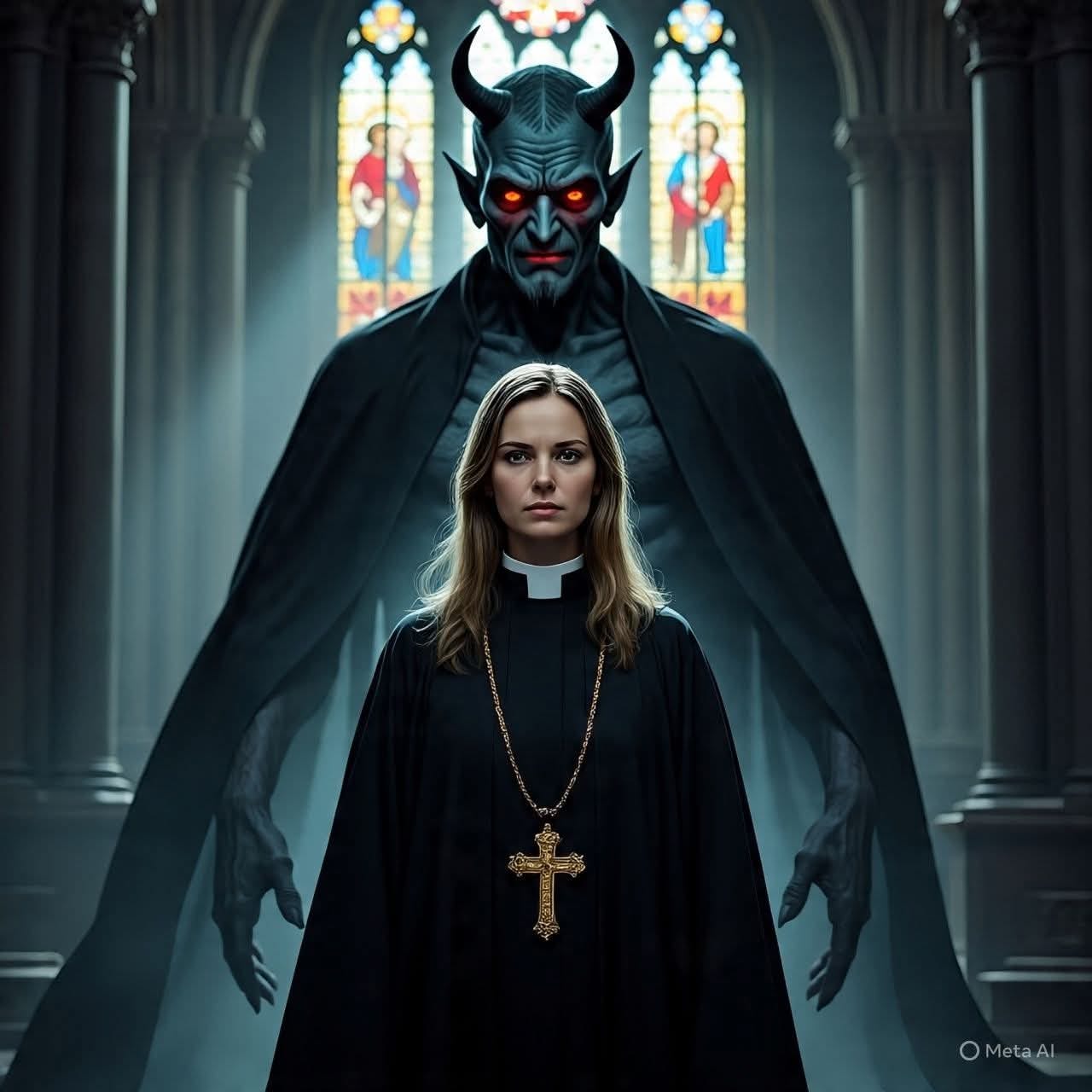
The synodal “synagogue of Satan” continues to promote its inverted and perverted neo-Catholicism, which has nothing in common with the Church and the Faith founded by Christ.
The liberal “Catholic” website Katolisch.English published a short report on 17 November, beginning with the following passage:
“Will women soon be able to become deacons in the Catholic Church? The results of a study commission appointed by the Pope for this purpose are to be announced soon. This emerges from a publication by the Vatican Synod Secretariat on Monday. It lists the status of investigations into a number of controversial issues in the Catholic Church.”
The report also excitedly—and unsurprisingly, considering we are dealing with liberal German “Catholics”—asks the question, “Is the Church opening up under the new Pope Leo XIV?”
This reflects a textbook modernist assumption: that doctrine evolves in order to accommodate the spirit of the age, rather than the faithful conforming themselves to the deposit of faith handed down from the Apostles.
Once again, we are told by this mouthpiece of “Catholic” progressivism that “reform-minded Catholics” (Protestants? – Ed.) have been “calling for years” for women to be admitted to all ecclesial ministries, including the diaconate. Yet nowhere in this announcement—nor in any of the predictable commentary that surrounds it—is there even a cursory acknowledgment that the Church has already spoken definitively and repeatedly on the impossibility of admitting women to Holy Orders.
The diaconate, whether one likes it or not, is not some free-floating ministry detached from the sacrament of Orders. It is the first grade of that sacrament, intrinsically connected to the priesthood and the episcopate, and therefore governed by the same divine constitution of the Church.
Traditional Catholic teaching has always been clear: women, by divine institution, are not recipients of the sacrament of Holy Orders—not because of any deficiency, moral, intellectual, or spiritual, but because Christ Himself established the sacramental sign in a way the Church has no authority whatsoever to alter. This is not a question of “leadership opportunities” or “institutional recognition.” It is a matter of obedience to Christ’s own example and the unbroken witness of Sacred Tradition.
Yet the Vatican’s two new committees behave as though they are free to re-engineer the very nature of the sacraments, as if the perennial Magisterium were merely an obstacle to administrative innovation. We now have one group tasked with examining the “life and leadership” roles of women—phrasing borrowed almost verbatim from the bureaucratic jargon of multinational corporations—and another charged with revisiting, yet again, the question of female deacons, as though the Church has been suffering for centuries from a failure of imagination.
This entire enterprise is propped up by the false premise that ministry in the Church is about power, status, and representation, rather than service according to the distinct vocations God has willed for men and women. Traditional Catholicism recognizes a truth that the modernizers seem determined to forget: the dignity of woman is rooted not in mimicking male ecclesial functions, but in the vocation God has entrusted to her—from the maternal mission of the family to the irreplaceable spiritual maternity embodied by Our Lady, the saints, and the great women religious.
To pretend that this God-given vocation is somehow insufficient until it is supplemented by ordination is a profound impoverishment. It is a blatant disregard for unchanging and unchangeable Truth.
The Synod Secretariat promises results “by the end of 2025,” implying that the Church must perpetually keep pace with the world’s latest ideological demands. As if blessing homosexual “unions” through papal photo opportunities and legitimising gender confusion by lunching with transgender activists did not make the aims of the synodal church clear, now they want to signal that they are working hard to pave the way for female “deaconesses”—which is, of course, merely the first step toward the abomination of female priests, just like their new best buddies and apparent role models, the Anglicans and Episcopalians.
The faithful deserve shepherds who will protect the truths of Holy Mother Church with clarity and courage, without bending the knee to the world. And if you haven’t realised it yet, your chances of finding such shepherds in the Frankensteinian synodal church are less than zero.
If the question is whether the Church is “opening up,” one must ask: Opening up to what? To the Holy Spirit, who safeguards the deposit of faith—or to the world’s ceaseless demands that the Church revise herself to become more palatable by soaking herself in its cesspool of Antichrist filth?
The current flirtation with a female diaconate is yet another step toward the completion of the Antichrist religion. And no number of committees, commissions, or synodal euphemisms can hide that.
A Short Explanation Why Women Cannot Become Priests or Deacons
The question of women’s ordination—whether to the priesthood or to the diaconate—is not a matter of policy, pastoral preference, or “opening up ministries.” It is a matter of divine constitution and sacramental reality, which no pope, synod, or commission has the authority to overturn.
Here are the central reasons, grounded in Scripture, Tradition, and the constant Magisterium of the Church:
Christ Himself Established the Male Priesthood
Our Lord freely chose only men to belong to the Twelve, despite the presence of holy and faithful women among His followers—women who displayed greater loyalty at the Cross than most of the Apostles. This choice was not cultural convenience; Christ repeatedly violated cultural expectations when it served His mission. His selection was deliberate, theological, and authoritative.
The Church, therefore, imitates Christ, not contemporary sociological trends.
Holy Orders Is a Single Sacrament
Some claim that women might be admitted to the diaconate because “deacons do not offer Mass.” This argument misunderstands the nature of Holy Orders.
The diaconate, priesthood, and episcopate are three degrees of one sacrament.
To admit women to one degree would imply the possibility of admitting them to all. The Church cannot contradict the inner unity of the sacrament Christ instituted.
Thus, if women cannot be priests—and the Church has definitively taught they cannot—they cannot be deacons either.
The Sacramental Sign Requires a Male Recipient
In a sacrament, the outward sign must correspond to the spiritual reality it represents. The priest acts in persona Christi, as a sacramental icon of Christ the Bridegroom offering Himself to His Bride, the Church.
This nuptial symbolism is not poetic ornamentation; it is integral to the sacramental economy.
A woman cannot sacramentally represent Christ as Bridegroom, just as a man cannot sacramentally represent the Church as Bride.
The sacramental sign would be theologically falsified.
The Unbroken Tradition of the Church Has Always Affirmed This
From the Apostolic Fathers through the Councils, the Church has consistently taught that ordination is reserved to men. Women have exercised countless indispensable roles—evangelizing, teaching, governing religious orders, spiritually mothering nations—but never the sacramental ministry of Orders.
Where “deaconesses” historically existed, they were not ordained, and their functions bore no resemblance to the sacramental diaconate.
To reinterpret history to justify innovation is intellectual dishonesty.
The Church Has Already Ruled Definitively
Even John Paul II declared in Ordinatio Sacerdotalis that the Church has no authority whatsoever to ordain women to the priesthood. The Congregation for the Doctrine of the Faith later confirmed that this teaching is infallible.
Because Holy Orders is one sacrament, this judgment extends to the diaconate as well.
The Church cannot invent authority she does not possess.
The Dignity of Women Is Not Dependent on Ordination
To deny women ordination is not to deny their dignity. Rather, it protects the integrity of the sacrament and honors the distinct vocation God has entrusted to women—rooted not in clerical functions but in spiritual maternity and sanctifying influence, as exemplified supremely by the Blessed Virgin Mary.
If ordination were necessary for dignity, then Our Lady—Queen of Heaven and Mother of the Church—would be somehow inferior to the least-ordained cleric. The opposite is true.
Women cannot become priests or deacons not because of cultural prejudice, but because Christ instituted the sacrament in a specific, unalterable form. The Church is custodian, not editor, of the sacraments. Any attempt to admit women to Holy Orders—at any level—would be a rupture with Scripture, Tradition, and the Church’s magisterial authority.
It is precisely by remaining faithful to the divine design, not by conforming to secular pressure, that the Church preserves both the integrity of her sacraments and the dignity of her daughters.
Our Lady, Co-redemptrix, pray for us…
Our Lady, Mediatrix of all Graces, pray for us…
Viva Christo Rey!
Also Read:
On Reverence and the Senile Synodal Grandfather “God”
Nuncio tells U.S. Bishops to Choose Between the “Path of Francis” and the Path of Christ
Vatican yet Again Promotes its New Religion of Communist Eco-Paganism at COP30
Some Notes on Leaving the Synodal Wasteland of Modernist-Induced Despair
Don’t Worry Everyone, according to the Pope no One is Going to Hell after all
For whatever reason, while reading this my thoughts wandered to the temptation of Eve by the serpent in the Garden of Eden.
It was not an accident that the serpent approached Eve rather than Adam. The serpent discerned an advantage to that. At that point, Eve had not sinned. So, we can’t say the serpent approached Eve first because Eve was more sinful, just as we cannot today say that women are more sinful than men. We cannot say that Eve was less loyal to God than Adam, at least not from what I can see in the biblical text (although the way Blessed Anne Catherine Emmerich tells it, it seems Adam spent much time contemplating God while Even spent much time contemplating creation).
The Bible describes the serpent as the most subtle of all creatures (Genesis 3:1). The most clever. Seemingly, the serpent thought Eve was more susceptible to his craft. Since the Bible text says explicitly that the serpent began to work on Eve by insinuating doubt followed by challenge about what God actually said, about what God actually meant, the serpent thought that the strategy of doubt followed by challenge would more likely succeed with Eve than with Adam.
And why was that? If we look at what appeals to Eve about the forbidden fruit, the 3 appeals come from appetite: good for food, delight to the eyes, desirable for wisdom. The serpent attacks Eve through the core of her feminine nature, a nature that is more affectively inclined than a man’s nature. God made woman that way, so that’s a very good thing, not a bad thing. But it requires the will to regulate self, just as a man must will to regulate the inclination of his masculine nature. This was the whole purpose of God’s command not to eat or touch the forbidden fruit: to move from the original state of complete innocence to a state of responsible obedience founded on love (cf. John 14:21).
There was a twin moral failure in the Garden. God had subjected everything in the Garden to Adam as steward. God appointed Adam to care for the Garden (cf. Genesis 2:15). That included Eve. God gave the command to avoid the forbidden fruit to Adam (2:16-17). Thus, it was Eve’s responsibility to ask Adam about the forbidden fruit and abide by his decision, but she proceeded along her own path. Even then, it was Adam’s responsibility to rectify or at least limit harm, but instead he accepted Eve’s invitation to eat the forbidden fruit. Thus, the twin moral failure: Eve didn’t ask permission of Adam as she should have, and Adam failed to correct her as he should have.
On this basis, perhaps it is easier to see this same dynamic in the pursuit of Holy Orders by women. It is ontologically impossible, not to mention theologically dubious and morally perilous, yet that’s what some women demand: the forbidden fruit of Holy Orders conveyed on them. And what do men do? Instead of correcting them, they inch closer and closer to joining them in heresy and sacrilege.
The point of my rambling is that we’re reliving the dynamics of the Temptation in the Garden. Satan is working on the emotional malleability of (some) women to their detriment while (some) irresponsible men accommodate and even enable them.
It appears another inquisition is overdue...