

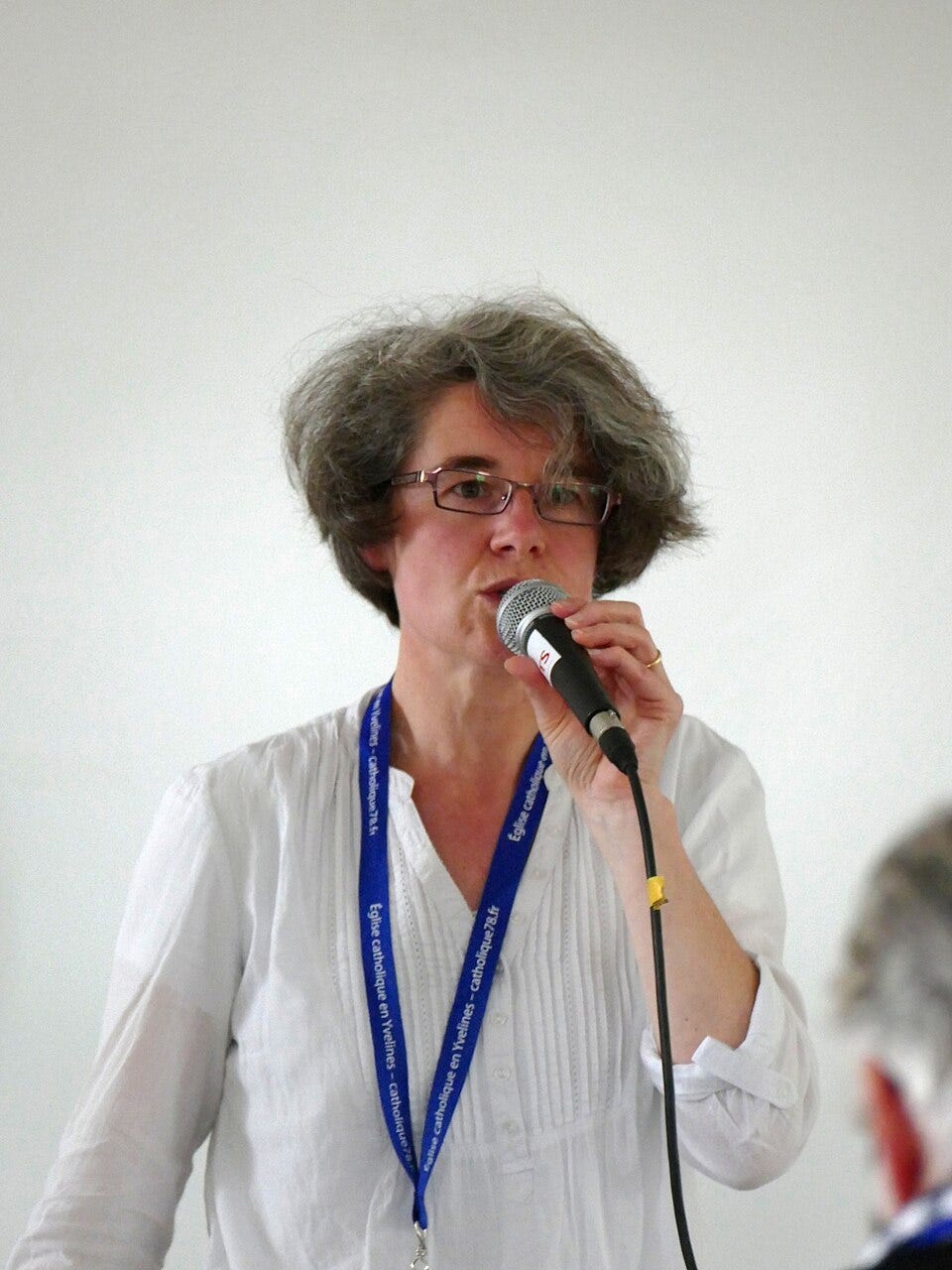
A large part of Radical Fidelity’s mission is to show, from as many angles as possible, that the sinister drivel flowing from the Vatican is not the real Catholic Faith.
It is not even a slight deviation, or a watered-down version, nor is it the aggiornamento (updating) that the wicked architects of the Second Vatican Council wanted us to believe. No, dear Catholic faithful, this is an altogether different beast. Actually, Beast with a capital B— as in Beast System, or something else that shares those initials.
But a different religion, nonetheless.
If I were merely some lunatic raving day after day about the superiority of Rugby over Iron Grid, or whether one political party is better than another, I could understand if people relegated my writings to the permanently deleted bin. They would be justified.
But that is not the case. If you believe extra ecclesiam nulla salus (there is no salvation outside the Church) and that the Catholic Church is the Church Christ promised in Matthew 16 and founded upon the Cross, then logic dictates that, for the sake of your eternal soul, you had better make sure not only that you find yourself in the Catholic Church, but also that the Church teaches what has been handed down through all the ages—at least up to 1962.
As I said, there are, of course, those who have read this far and whose eyes by now have glazed over due to the modernist spiritual fluoride they have been ingesting through the “spirit of Vatican II” and its diabolical culmination, namely Synodality. These people are probably staring blankly at their screens right now, wondering what I am on about.
But for those who still have two brain cells dialoguing and some semblance of rationality left, I would like once again not only to show, but to prove, that this is a different religion from the Catholicism of the ages.
And of course, who better to support my argument than the very highest-ranking proponents of this false new religion? In this case, unsurprisingly, a woman. And not just any woman, but one who is being called the “most powerful woman in the Vatican” and was ranked as one of the 50 most powerful women in the world by the U.S. magazine Forbes. That alone should tell you a lot.
Let me introduce you to French theologian and “nun” Nathalie Becquart, the Undersecretary of the General Secretariat of the Synod.
Katolisch.English, the German Church’s mouthpiece, published a shockingly revealing interview with her—especially when it comes to the “it-is-a-different-religion” department.
You can read the whole piece of textualized vomit here, but I want to pause and focus on only some of her replies.
So put on your spiritual Hazmat suit, and follow me.
“Question: Pope Leo XIV referred to “cultural differences” in the implementation process. How can synodality be lived in such different contexts without jeopardising the unity of the Church?
Becquart: The Pope was very clear when he made it clear that the Church was not looking for a standardised model. Synodality will not consist of a model in which everyone and every country says: this is how it has to be done. In his response to the General Secretary of SECAM, he emphasised that the respective local reality must be respected. There are many ways of being church and that no single model of church life should be imposed. We emphasise the local church, but at the same time underline the importance of strengthening dialogue between the local churches - at the level of the church provinces, the bishops’ conferences and the continent.”
The claim that “there are many ways of being Church and no single model of church life should be imposed” stands in direct contrast with the Church’s perennial teaching on unity, universality, and divine constitution. The Catholic Church has always understood herself not as a federation of culturally defined communities, but as a single, visible, hierarchically ordered society instituted by Christ. Her unity is one of the four essential marks: a unity of faith, sacraments, and governance under the Roman Pontiff. Popes from Leo XIII in Satis Cognitum to Pius XII in Mystici Corporis consistently taught that the Church possesses a determinate form, structure, and mission that do not fluctuate with sociological context. To imply that no single model of ecclesial life should guide the Church suggests that her very constitution is malleable, evolving from below rather than received from Christ.
While the Church recognizes legitimate diversity in customs, devotions, and certain liturgical expressions, such variations are accidental, not essential. They cannot replace or relativize the universal structure of the Church’s teaching, sacramental economy, and hierarchical governance. Elevating cultural context to the point of defining “many ways of being Church” confuses these accidental expressions with the Church’s divine essence. It risks reducing Catholicism to a set of localized experiments rather than the universal Mystical Body of Christ whose form is fixed, not invented by each region. The suggestion that no model should ever be imposed contradicts Christ’s mandate to “teach all nations,” which presupposes a universally binding content and form that local cultures are called to receive—not reshape according to preference.
Such an approach introduces fragmentation, relativism, and a weakening of doctrinal and liturgical unity. It resembles the ecclesial pluralism characteristic of Protestant denominations or the Anglican Communion rather than the Catholic Church, whose unbroken tradition insists that unity is visible, concrete, and safeguarded by adherence to the same faith and the same apostolic structure everywhere. True synodality, understood within the Church’s tradition, cannot mean multiple divergent models of ecclesial life, but rather the harmonious participation of the faithful within the one, universal model given by Christ and preserved through the ages.
“Question: Is it a problem that there are obviously very different views on what synodality actually means?
Becquart: The final document of the Synod on Synodality offers a clear understanding: synodality is both a way of being church - as the pilgrim people of God - and a way of carrying out the mission of the church together, as baptised people called to be missionary disciples. It goes hand in hand with ecumenism, but also with interreligious dialogue, dialogue with society and all people, and emphasises the importance of listening to everyone, especially the poor and marginalised. Pope Leo makes it clear that synodality - as the Synod also emphasised - is always geared towards mission.”
This answer is highly alarming because it replaces the Church’s divine mandate with a soft, sociological vision that sounds more like an arm of the UN than the Mystical Body of Christ. To claim that synodality [and therefor the Church] is chiefly about “listening to everyone,” engaging in interreligious dialogue, and responding to society is to empty the her of her supernatural identity and substitute it with a horizontal, world-pleasing agenda. The Church does not discover her mission by surveying public opinion; she receives it directly from Christ, who commanded her not to dialogue with the nations but to teach them, to baptize them, and to call them to repentance and truth. Elevating “dialogue” to a defining mark of synodality turns the Church outward in all the wrong ways—absorbing the spirit of the age rather than converting it. But this is exactly what the new religion is all about.
Even more troubling is the flattening of the Church’s hierarchical structure by reducing mission to a collective activity of “all the baptized.” This blurs the God-given distinction between the ministerial priesthood and the faithful, replacing the apostolic authority of the successors of the Apostles with a kind of spiritual populism. The apostolic mission is not a group project—it is a divinely conferred office passed down through Holy Orders, charged with preaching the truth with authority.
By presenting synodality as a feel-good process of universal listening rather than a call to proclaim doctrinal truth, shows that it is nothing but dangerous relativism. Such a vision is not merely inadequate—it is diametrically opposed to the perennial Catholic teaching that the Church exists to save souls, not mirror the world’s expectations.
But again, as I said in my previous article, this is no accident. Becquart is not some badly catechized layperson; she is, after all, a theologian and a powerful player in the Vatican’s new hierarchy of synodal usurpers, and she is telling the whole world what the new religion of synodality aims to accomplish. It is safe to say it is not the salvation of souls.
What follows is especially telling, and a textbook example of the old modernist ploy of using an existing term but redefining it in an ambiguous way.
“Question: What does mission mean in this case?
Becquart: Being missionary means proclaiming the Gospel. It is not a campaign, but a way of life and a way of being Church. As Pope Leo said, it promotes an attitude that begins with listening to one another.”
It is laughable. Not only can she not say that the Church of Christ’s mission is the salvation of souls, but she reduces it to the nonsensical and vague “attitude that begins with listening to one another.” More so dear reader, you must understand that the satanic synodalist gospel is different from the Gospel. It is not the good news that Christ came to reconcile us with God through His sacrifice but, to quote Bishop Richard Williamson, that “we must all be nice to each other”! God help us!
Elsewhere, Becquart tells us that “The document for the implementation phase emphasises that we need to invest in practices to implement synodality. It’s not just about talking about it, but about opening up concrete experiments - and these have already begun. There is not just one way to do this. Synodality must be based on the respective situation and context” and “The document reminds us that experimentation must be part of the discernment and decision-making processes provided for by the law and by the document itself. In his homily at the Jubilee, Pope Leo XIV emphasised that discernment requires inner freedom, humility, prayer, mutual trust and openness to the new”!
She might as well have said that we are going to make everything up as we go along, based on our vague sinful emotions and filthy passions! She would have saved everybody a lot of time and gone straight to the truth!
Now let us take a look what the Catholic Church has always taught about innovation and experimentation, and you decide whether Becquart’s Synodal Curch is the same religion…
St. Vincent of Lérins (5th century)
Commonitorium, ch. 23
“In the Catholic Church itself, all possible care must be taken that we hold that faith which has been believed everywhere, always, and by all.”
“…it should be progress by way of development, not alteration; the growth of the understanding, knowledge, and wisdom of individuals as of the whole Church must take place according to its own kind, the same doctrine, the same meaning, and the same judgment.”
This is the classic statement against introducing new doctrines.
Pope St. Pius X (1903), Tra le Sollecitudini
“The primary and indispensable source of the true Christian spirit is the active participation in the most holy mysteries… It must be understood above all that the liturgy of the Church is not subject to the whim and caprice of private individuals… No one is permitted to alter the established rites, or to introduce new ones.”
This is about liturgical innovation.
Pope Benedict XV (1914), Ad Beatissimi Apostolorum
“The Church… should never abandon that sacred patrimony of the Fathers, nor tolerate the least deviation from it.”
Pope Pius IX, First Vatican Council (1870)
Dogmatic Constitution Dei Filius
“For the doctrine of the faith which God has revealed has not been proposed like a philosophical invention to be perfected by human ingenuity, but has been entrusted as a divine deposit to the Spouse of Christ to be faithfully kept and infallibly declared.”
Here the Council explicitly rejects innovation in doctrine.
Pope St. Pius V (1570), Quo Primum (Missal promulgation)
“By this present document… We order and enjoin that nothing must be added to, omitted from, or changed in this Missal.”
Though addressing the Roman Missal, this has been historically used as a principle against innovation.
Pope Leo XIII (1899), Testem Benevolentiae
“The Church is the guardian of the truths deposited by Christ; she neither adds to them nor takes away from them.”
Written against the rise of “Americanism.”
Pope Gregory XVI (1832), Mirari Vos
“Let nothing new be introduced, but only what has been handed down.”
This is one of the clearest pre–Vatican II statements against innovation.
Council of Trent (1545–1563), Session 22
“If anyone says that the rites of the Catholic Church may be despised or omitted at will or changed into other new rites … let him be anathema.”
Pope St. Celestine I (A.D. 422–432)
Letter to the bishops of Gaul (often quoted at Council of Ephesus)
“Let nothing be added to the faith once delivered, let nothing be taken away.”
This formula became a standard in later doctrinal definitions.
Council of Ephesus (A.D. 431) – Ecumenical Council
In the Council’s definition following St. Celestine:
“It is unlawful for anyone to bring forward a different faith as a rival to that defined by the holy Fathers.”
This is one of the first conciliar condemnations of doctrinal innovation.
First Vatican Council (1870)
Dogmatic Constitution Dei Filius
“The meaning of the sacred dogmas is ever to be retained which Holy Mother Church has once declared; and there must never be any retreat from this meaning under the name of a deeper understanding.”
This is an infallible statement rejecting doctrinal alteration.
Pope St. Leo the Great (A.D. 440–461)
Sermon 62, on the Nativity
“The faith shall not vary in any age; for the Lord has said: My doctrine is not mine, but His who sent me.
Nothing may be added, nothing taken away.”
Leo is one of the most cited Fathers against innovation.
Pope St. Agatho (A.D. 678–681)
Letter to the Sixth Ecumenical Council
“The Apostolic Church of Christ… is proved never to have erred from the path of apostolic tradition, and has never corrupted the faith by any innovation.”
This letter was accepted by the Council and thus has conciliar authority.
St. Irenaeus of Lyons (A.D. 180)
Against Heresies 3.3.1
“The Church, having received this preaching and this faith, although scattered throughout the whole world, carefully preserves it.
She neither adds to what has been handed down, nor takes away.”
A very early witness to the unchangeability of doctrine.
Fourth Lateran Council (1215)
Profession of Faith
“We firmly believe and confess that there is but one universal Church of the faithful, outside of which none can be saved. This faith the Church firmly holds, without change, to the end of the world.”
A dogmatic Council stating that the faith is unchangeable.
Council of Trent (1546)
Decree on Scripture and Tradition
“The Gospel, promised beforehand through the prophets… was first promulgated by Christ, and then by the apostles as the source of all saving truth and moral discipline;
and the Church receives it as a deposit, to be preserved inviolate.”
So, there you have it. Not a word about allowing innovation, experimentation or having an “openess to the new”. Clearly Becquart’s new religion is completely opposed to Catholicism.
Clearly it is a different religion.
Period.
Our Lady, Co-redemptrix, pray for us…
Our Lady, Mediatrix of all Graces, pray for us…
Viva Christo Rey!
Also Read:
More Synodal Church Lunacy from the You-Can’t-Make-This-Up Department…
“You Are Welcoming Sin”: Young Traditional Catholic Publicly Confronts Sin-Affirming Priest
Is the Synodal Church Signalling the Imminence of Female Deacons (and Priests)?
On Reverence and the Senile Synodal Grandfather “God”
Nuncio tells U.S. Bishops to Choose Between the “Path of Francis” and the Path of Christ
“we must all be nice to each other”: The word "nice" originates from the Latin nescius, meaning "ignorant" or "not knowing," derived from ne- ("not") and scire ("to know").
Sr. Becquart's blather reminds me of some of the "Prayers of the Faithful" that I have heard.