

It has long been the conviction of the saints, of our fathers in the faith, and of those who never succumbed to the intoxication of novelty that the way we worship determines what we believe.
The ancient maxim lex orandi, lex credendi is not a quaint proverb but a description of reality. Now, to the embarrassment of those who dismissed such claims as “nostalgic romanticism,” modern social science has put numbers to what Tradition has always known. A recent study by Dr. Natalie A. Lindemann, published in the Catholic Social Science Review, demonstrates with precision that the manner of our liturgical life directly affects the strength—or the collapse—of Eucharistic faith.
The picture is grim. Of 860 American Catholics surveyed, barely one-third expressed unshaken belief that Our Lord is truly, really, substantially present in the Blessed Sacrament. Almost a quarter confidently declared that the Eucharist is a mere symbol. The rest flounder in a fog of probability, doubt, or indifference. One need not be a prophet to see the consequence. If only a minority believes, then the crisis in the Church is not primarily organizational, political, or even moral, but sacramental. And yet, Lindemann’s data reveal something far more telling—that Eucharistic belief is not distributed at random, nor is it merely a question of catechesis. Rather, it correlates strongly with concrete liturgical practices that for centuries were considered ordinary and essential.
Consider the most intimate moment of the Mass: Holy Communion. Catholics who have ever received on the tongue score significantly higher in Eucharistic belief than those who have never done so. The difference is not trivial; it marks the contrast between conviction and half-hearted assent. Among those who always receive on the tongue, belief climbs even higher, averaging close to four out of five on Lindemann’s measure of certainty. By contrast, those who always receive in the hand languish around three. More telling still, when asked not about their personal practice but about what should be the universal mode of reception, the divide becomes chasmic. Those who insist everyone ought to receive on the tongue average over 4.3—approaching total certainty in the Real Presence. Those who promote communion in the hand sink to 2.6, closer to disbelief than belief. Can anyone seriously maintain that the method of reception is a matter of indifference, when the data show such a stark gulf in faith?
The same pattern emerges in other signs of reverence. Consecration bells, once ubiquitous, are now absent in many parishes after decades of ill-advised “reform.” Yet Lindemann’s survey shows that those who have always heard the bells during the Canon have much stronger faith than those who have never heard them. Again the numbers speak clearly. Belief scores in the mid-threes compared with the low twos, almost a full point’s difference on a five-point scale. These are not decorations, not optional ornaments, but catechetical instruments that engrave the mystery on the soul. When the bells ring, the faithful know: something extraordinary is happening, something not of this world. Remove the bells, and the sense of awe evaporates.
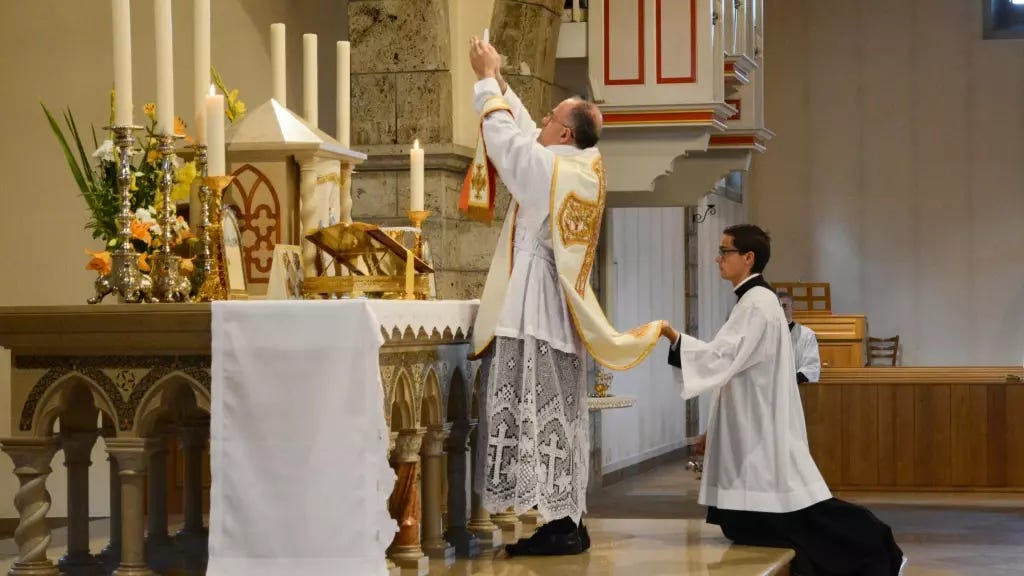
Perhaps the most decisive contrast, however, is found in relation to the Traditional Latin Mass. Catholics whose parishes offer the ancient liturgy show markedly stronger belief in the Real Presence than those with no access to it. Those who have attended personally are stronger still, climbing well above the average of their peers. And those who hold a positive view of the old Mass stand far above those who sneer at it, who—tellingly—register levels of Eucharistic belief scarcely distinguishable from Protestant minimalism. This is no coincidence. The ancient Mass is not merely “more beautiful” or “more solemn.” It is a school of faith, shaping the body to kneel, the tongue to receive, the ear to hear silence and bells, the mind to contemplate mystery rather than chatter.
Even the broader patterns fit the picture. Frequent Mass attendance correlates strongly with belief in the Real Presence, but attendance alone is not enough. The form and gestures of the Mass make all the difference. Conservative political outlook also correlates, while factors such as age, sex, and even the placement of the Tabernacle show little significance. The obvious conclusion is that belief in the Eucharist is not simply a matter of demographic accident, but of spiritual formation through liturgical practice.
The implications should be obvious to anyone not blinded by ideology. The decline in Eucharistic faith is not a mystery, not an inscrutable act of Providence, but the direct and predictable result of decades of desacralization. Communion in the hand, standing reception, the abolition of rails, the silencing of bells, the replacement of ancient prayers with banal formulae, the elevation of pastoral “creativity” over reverent uniformity—all these were sold as pastoral adaptations to modern man. The result has been empty pews, empty tabernacles, and empty hearts. The Church in the West is littered with parishes where the Blessed Sacrament is treated as a symbol, where faith in the Real Presence has withered because the signs that taught reverence were stripped away.
What, then, is to be done? The study points to the same remedies the faithful have been begging for since the upheavals of the 1960s. Restore Communion on the tongue and on the knees. Reinstate consecration bells. Limit distribution of the Sacred Species to the priest. Reintroduce the Traditional Latin Mass, not as a tolerated curiosity, but as a living fountain of Catholic life. None of these measures is cosmetic. They are visible, tangible, audible acts that shape the soul, catechize the faithful, and convey through the body what the mind professes: that Christ is truly present, whole and entire, Body, Blood, Soul, and Divinity.
It is not enough for bishops to announce “Eucharistic revivals” while clinging to the very practices that have eroded belief. No program of slogans or rallies will suffice if the liturgy itself continues to whisper doubt. If the Church wishes to restore Eucharistic faith, it must restore Eucharistic worship. The bells must ring, the knees must bend, the tongue must confess by gesture what the lips profess in creed. And above all, the Mass of Ages must be celebrated and loved, for it alone has proven over centuries to be the surest refuge of faith.
Tradition did not need the validation of social science, yet Providence has allowed the academy itself to confirm what our fathers never doubted. We now have not only the testimony of saints but the data of scholars. The conclusion is the same. How we pray is how we believe. For too long we have prayed as though Christ were absent, and so the people no longer believe He is present. Restore the sacred, and faith will return. Ignore it, and watch the faith vanish entirely. The choice before the Church is stark: reform the reforms, or resign ourselves to disbelief.
The time for hesitation is over. The numbers are in. The verdict is clear. And the voice of Tradition is vindicated once again.
Also Read:
Christus vincit!
Christus regnat!
Christus imperat!
A Testimony on Our First Birthday: Whatsoever He Shall Say to You, do Ye
In Defense of Catholic Fundamentalism
Honestly, I say this as an outsider coming in, a Catholic Church without the real presence strips itself of any realistic claim to authority. It is my view that if you don’t have the real presence then you don’t have anything. Sure you have a history, beautiful buildings, a lot of objectively nice things but nothing other people couldn’t have, build or create naturally. The real presence of our Lord is the most precious thing the Church holds and if it doesn’t have that then it will wither on the vine as our Lord said it would.
The TLM is I believe vital ….as is the Doctrine of the Catholic Church. You recall the one which does not can not change.