

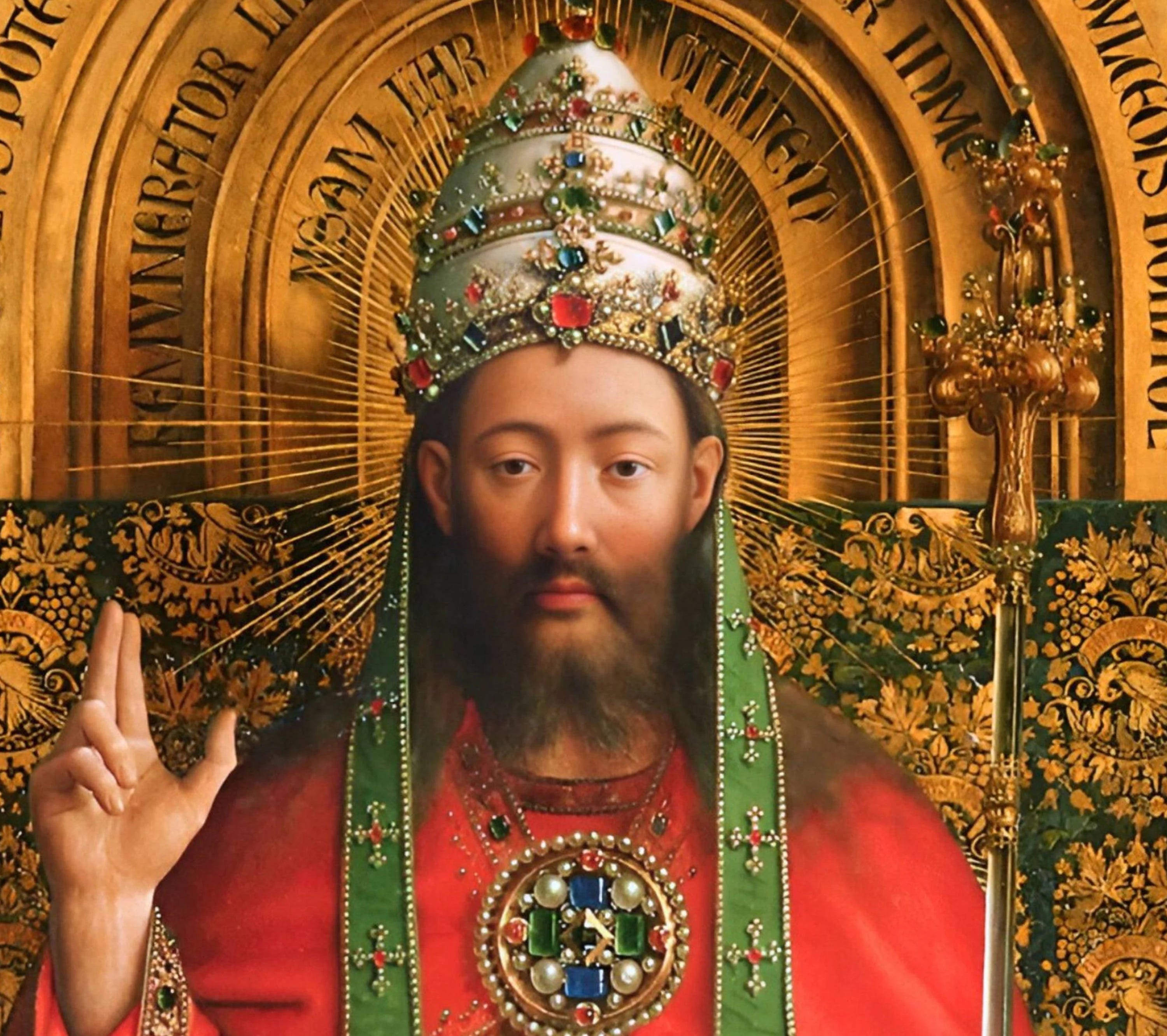
You have a greater chance of running into a dinosaur in New York City, than hearing a modernist boldly proclaiming the need for Christ’s Kingship.
Even less so when the modernist’s secular friends are watching. After all, pandering to the kingdom of Satan is much more important to them.
Pope Leo XIV’s recent address to the European Parliament’s ‘Working Group on Intercultural and Interreligious Dialogue’, is a perfect example of this and must be read with great care—and, indeed, with grave concern. While cloaked in the language of “dialogue,” “healthy secularism,” and “openness,” the message betrays a deeper problem: a failure to proclaim Christ’s kingship over nations, and a dangerous accommodation to the secularist mindset that has already hollowed out Europe’s Christian foundations.
The Holy Father speaks of a “healthy secularism,” which purportedly “affirms the value of religion while maintaining its distinction—neither separation nor mixing—from the political sphere.” But what does this mean in practice? To sever politics from the binding authority of Christ the King, while retaining a vague “value of religion,” is not Catholic teaching—it is a soft relativism dressed up as prudence. The perennial Magisterium has never spoken of a “healthy secularism,” but rather of the Social Kingship of Christ, as taught most clearly by Pope Pius XI in Quas Primas. Catholic truth is not one “option” among many in the public square; it is the only sure foundation for true justice and authentic peace.
Moreover, the call for Christian politicians to be primarily “men and women of dialogue” reduces their mission to endless conversation. Dialogue, as promoted here, easily becomes a substitute for evangelization, as though mutual listening were more important than proclaiming the Gospel. Yet Our Lord gave the apostles the Great Commission—not to dialogue endlessly with pagans, but to teach and baptize all nations (cf. Mt 28:19–20).
It is telling that the Pope invokes the names of Schuman, Adenauer, and De Gasperi—men who laid the groundwork for the secular, technocratic European Union we see today, which has relentlessly advanced abortion, same-sex “marriage,” and anti-Christian legislation. To hold them up as models without qualification is to baptize a project that has long since cut itself off from Christ.
What Europe needs is not another appeal to vague “human dignity” and interreligious chatter, but a prophetic voice calling the continent back to the Kingship of Christ. Without the law of the Gospel guiding politics, “healthy secularism” becomes simply secularism, and dialogue becomes surrender. The Catholic politician’s true mandate is not to keep religion politely in its “sphere,” but to confess Christ openly, legislate according to His law, and order society to the glory of God. Anything less is compromise.
In an age when Christendom has been dismantled, Catholics must resist the temptation to content themselves with half-measures and ambiguous formulas. Neither the world, or Europe for that matter, needs dialogue; it needs conversion. It does not need secularism—healthy or otherwise—but the reign of Christ the King.
Read These to Find out What the Church Always Taught About the Kingship of Christ vs The State
The Catholic Church developed a rich body of teaching on the Kingship of Christ prior to the Second Vatican Council, particularly in response to the rise of secularism, liberalism, socialism, and nationalism in the modern era. This tradition culminated in Pope Pius XI’s encyclical Quas Primas (1925), which established the Feast of Christ the King and articulated with clarity that Christ is King not only of individual souls and the Church, but also of societies, nations, and governments. Pius XI insisted that genuine peace can only be achieved when states recognize Christ’s authority and order their laws and institutions accordingly. Closely related to this was his earlier encyclical Ubi Arcano Dei Consilio (1922), issued in the aftermath of the First World War, which taught that authentic peace flows from acknowledging the reign of Christ both in private and public life.
This doctrine had been carefully prepared by his predecessors, especially Leo XIII, who systematically laid out Catholic social and political philosophy. In Immortale Dei (1885), Leo XIII expounded the Christian constitution of states, affirming that governments must acknowledge the sovereignty of Christ and the authority of His Church. In Diuturnum Illud (1881), he explained that while peoples may choose the form of their government, all political power ultimately derives from God. His landmark encyclical Libertas Praestantissimum (1888) clarified the Church’s understanding of liberty, distinguishing authentic freedom—living in accordance with God’s law—from the false liberty of indifferentism and license. In Sapientiae Christianae (1890), he addressed the duties of Christians as citizens, stressing that while Catholics should be loyal and responsible members of society, their first obedience is owed to God when human laws contradict divine law. Finally, in Annum Sacrum (1899), Leo XIII deepened the link between the Kingship of Christ and devotion to the Sacred Heart, consecrating the entire human race to Christ the King.
Earlier popes had already laid the groundwork for this teaching. Gregory XVI’s Mirari Vos (1832) condemned religious indifferentism and the separation of Church and state when it meant ignoring Christ’s sovereign rights. Pius IX’s Quanta Cura (1864), together with the Syllabus of Errors, explicitly rejected modern political theories that denied the rightful union of society with Christ’s law. Building on this, St. Pius X opened his pontificate with E Supremi Apostolatus (1903), declaring his program to be the restoration of all things in Christ (Instaurare Omnia in Christo). His encyclical Il Fermo Proposito (1905) further encouraged Catholic Action, calling on the faithful to engage actively in political and social life so as to restore society to Christ.
Taken together, these documents form a coherent trajectory of magisterial teaching on the social Kingship of Christ. From the initial resistance to secular liberalism under Gregory XVI and Pius IX, through the systematic articulation of Catholic political philosophy under Leo XIII, to the program of restoration under Pius X, and finally to the solemn institution of the Feast of Christ the King by Pius XI, the Church consistently affirmed that Christ is not only Lord of the Church and of individual souls, but also the true King of nations and societies.
Christus vincit!
Christus regnat!
Christus imperat!
Dialogue. Loyola University, Chicago, 1971, Moral Theology class taught by Fr. Joseph Mangen, SJ. Humanae Vitae was still very much in the air. And if you disagreed with Fr. Mangan's defense of Catholic teaching, he said, "Come, talk to me; we'll dialogue." I remember thinking at the time, Father Mangan is using a current buzz word, and he means just the opposite. A very good priest, and for him dialogue meant, "I am going to present Catholic teaching, and you can accept or reject." Alas, the word doesn't mean that to any Churchmen today. It means, to conceal the Faith.
The title of Prevost's speech says everything we need to know about who and what Prevost is; that being a modernist, a secularist, and a heretic for he rarely even mentions God, nor does he ever talk about salus animarum, suprema lex which is indeed the supreme law of the Catholic Church.
I thank God daily that we found a true TLM in CMRI as it conforms with the Traditional Magisterium of the Church as it existed for millennia prior to the abomination of VII.