

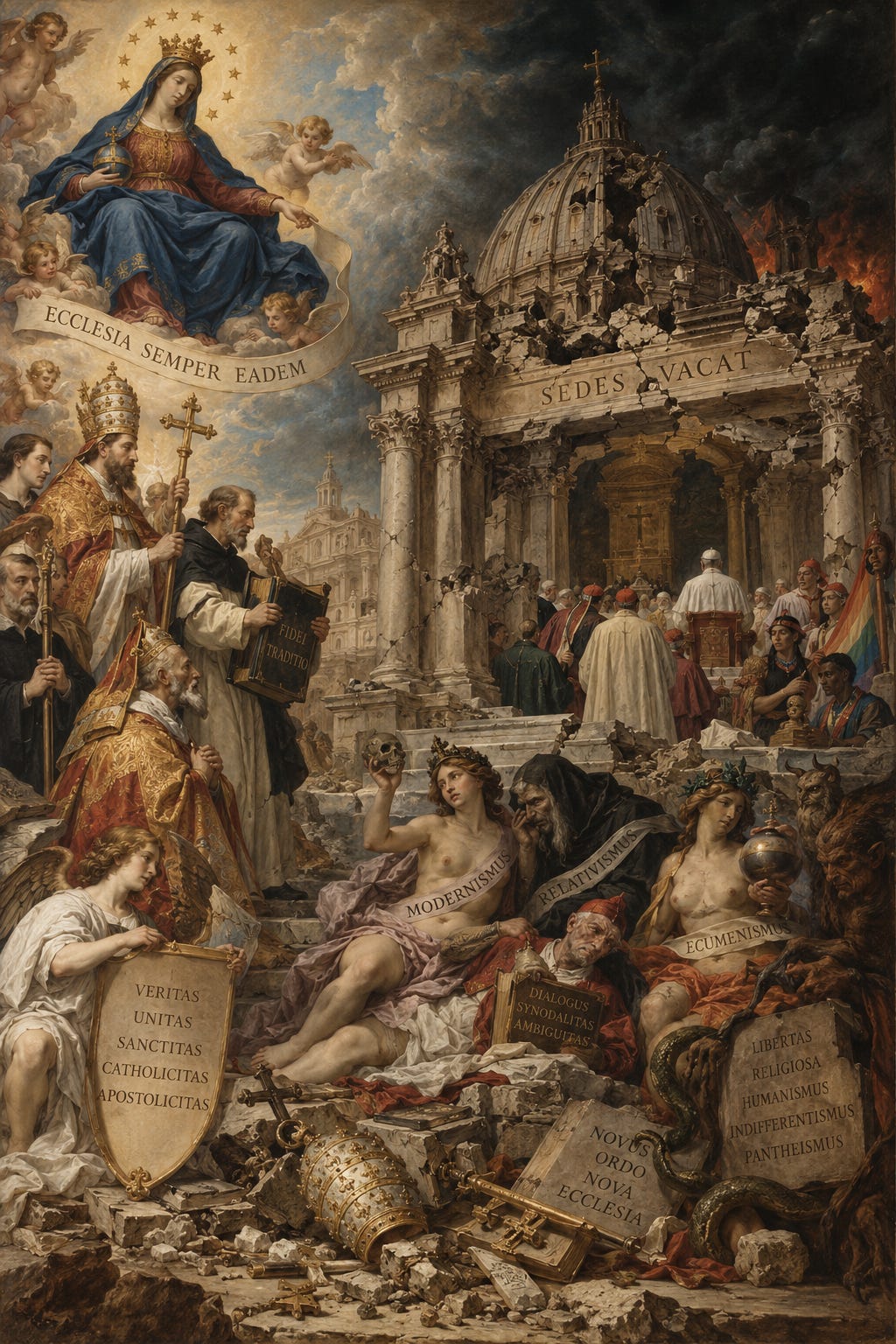
Earlier this week, two gentlemen, “Jacques” and “Chad,” had a go at each other in the comment section of an article I published on September 23, titled “A Harsh Question for Those Who Still Refuse to Reject the Synodal Circus.”
While saying they “had a go at each other” might create the wrong impression, the truth is that it was a master class in what debating on the internet can look like. “Chad,” a sedevacantist, and “Jacques,” a member of the Novus Ordo “church,” brought well articulated arguments to the table. Even though I do not agree with the latter’s position, they were courteous and charitable, and not once did the interaction become nasty. I really encourage my readers to click on the link, go to the comment section, and take a look.
But this essay is not about their arguments or who won the mini-debate, but rather about a statement “Jacques” made in his opening salvo.
“I am still unsure how you come to the conviction that a Church in crisis is not the Church and a pope I disagree with is not a pope…,” wrote “Jacques.”
“A Church in crisis” was the phrase that jumped out at me, and it has been bothering me for a long time, even though I myself am guilty of using it from time to time.
Bear with me for a while, and let me explain why we should stop using this phrase, or any variation of it.
For 61 years, Catholics have spoken of “the crisis in the Church.” The phrase has become so commonplace that few stop to consider what it means beyond a laundry list of postconciliar crimes.
We hear of a crisis of doctrine, authority, liturgy, vocations, and faith and are told that the Church has embraced dangerous novelties, imposed a Protestantized liturgy, and adopted principles contrary to those taught before the Second Vatican Council.
All these accusations are, of course, tragically true, but precisely because they are true, we should not call the situation a “crisis in the Church.”
Why? Because all of the above are characteristics and symptoms, if you like, of a false religion, and the Catholic Church cannot become a false religion.
Christ founded His Church as a visible, supernatural society and promised that the gates of hell would not prevail against her. He commissioned her to teach all nations and promised to remain with her until the consummation of the world.
This means the Church possesses indefectibility, and while she can suffer persecution, scandal, corruption, bad bishops, wicked priests, and disastrous popes, she cannot cease to be what Christ established.
What emerged from Vatican II substantially and grossly contradicts the Catholic religion that preceded it. Therefore, the conclusion cannot be that the Catholic Church herself defected, but rather that the institution promulgating those contradictions does not possess the authority it claims.
That is why we should stop calling this “the crisis in the Church,” as the only “crisis” is one of mistaken identity.
The Church Cannot Defect
Indefectibility does not mean that every Catholic will remain faithful, that bishops cannot fall into heresy, that priests cannot apostatize, or even that entire nations cannot abandon the Faith. But saying that these scenarios can happen is radically different from saying that the Catholic Church can officially give the faithful a corrupted religion.
Let us recap some of the typical things traditional Catholics routinely say happened after Vatican II. Rome promulgated a new liturgy that is dangerous to the Faith; the hierarchy embraced teachings concerning ecumenism, religious liberty, and non-Catholic religions that are totally irreconcilable with previous papal teaching; and practices formerly condemned as indifferentism are now ordinary features of the ecclesiastical life of this new “church.”
When you call all of the above a crisis, you are merely giving it a label, but you are definitely not solving the theological problem.
If the Church can officially teach the universal faithful a substantially false religion, establish harmful worship, promote false principles, and systematically direct souls toward hell, then clearly its claim to indefectibility must be false.
Sadly, Catholics today are so busy solving the ecclesiastical puzzle of determining what part of this church is “Catholic” and what part is a “false religion” that it seems they have forgotten that Christ established a teaching Church. By doing this, even though well-meaning, they are weakening the true Church’s claim to indefectibility and failing to ask the right question: Does this new “church” and its new religion actually possess Catholic authority?
The Empty Chair
The papal office and the man apparently occupying it are not identical. While Catholics have to believe that Christ established the papacy, they do not necessarily have to believe that merely claiming the papacy makes a man the pope.
The possibility that the Roman See is vacant does not abolish the papacy any more than the vacancy between the death of one pope and the election of another abolishes it. The position that actually protects the papacy, therefore, is not that the papacy has disappeared, but that the papal office has remained vacant during this extraordinary period.
Those who want to defend this false church, its false religion, and its false papal claimants have to explain how an alleged pope who possesses the full authority of the Roman Pontiff—and how this authority established by Christ—can become the principal instrument through which the traditional Faith is being dismantled and demolished.
This is exactly what makes the “recognize and resist” position so problematic. Treating the universal doctrinal, disciplinary, and liturgical activity of the Holy See as a theological minefield for six consecutive decades ends up destroying the very meaning of the authority Christ intended it to possess.
Papal Infallibility Is Part of the Answer
While infallibility does not mean that everything a pope says is inspired or incapable of error, it is also not an almost meaningless privilege protecting only a few isolated sentences in Church history.
Vatican I taught that the pope is infallible when definitively teaching faith or morals to the whole Church. This authority safeguards doctrinal unity and does not require Catholics to judge and resist a supposedly true pope.
Properly understood, papal infallibility and the Church’s indefectibility therefore support considering a vacancy of the Roman See rather than attributing the postconciliar revolution to the Catholic Church.
We refuse to attribute the postconciliar revolution to the Catholic Church because we take the Church’s divine protection seriously.
Two Religions Cannot Be One
Now let’s do a quick comparison between what Catholicism was prior to Vatican II and what “Catholicism” supposedly became in the aftermath of this wicked council.
The old religion proclaimed the Catholic Church as the one true Church of Christ and sought the conversion of non-Catholics. Its liturgy presented the Mass unmistakably as a propitiatory sacrifice offered by a sacrificing priest, and its missionaries sought to bring men out of false religions and into the Catholic Church. It vehemently condemned religious indifferentism.
Now let us look at the disastrous and dangerous postconciliar religion, and we will see that its principles directly contradict those of Catholicism.
Its ecumenical character grants separated religious bodies a significance foreign to traditional Catholic practice, and its teaching on religious liberty departs from the older understanding of the rights of truth and the duties of states toward the true religion.
Its liturgical revolution replaced the traditional Roman Mass with a reconstructed rite formed during the ecumenical age, and its impostor hierarchy has repeatedly participated in interreligious activities that Catholicism deems idolatrous, pagan, and incompatible with the Faith.
This leaves us with only two possibilities.
Either the Catholic Church herself underwent this transformation, requiring us to explain how that would be compatible with her indefectibility, holiness, and doctrinal authority, or the institution responsible for the transformation, despite controlling historically Catholic structures, is not the Roman Catholic Church.
While the latter conclusion is terrible to accept for those who love the Catholic Church, the former is, by far, theologically worse.
Buildings Do Not Make the Church
Where most people get tripped up is visibility.
They see St. Peter’s Basilica, ancient dioceses, bishops occupying historic cathedrals, Vatican offices, seminaries, parishes, religious orders, and institutions possessing “continuity” with those existing before the Council, and conclude that this must be the Catholic Church.
The reality is that Satan has tricked them into confusing Catholic property with Catholic authority.
Throughout history, heretics and schismatics have occupied churches built by Catholics, governments have confiscated Catholic institutions, and intruders have claimed ecclesiastical offices.
Not once did the fact that they possessed the buildings, titles, and vestments “make” them Catholic or give them the authority of Christ’s Church. Neither does it today.
This is exactly what makes the postconciliar usurpation so evil and deceptive. It did not, like the Protestants, create a breakaway religious institution, but merely transformed the religion practiced within these visible structures.
The Church Has Not Failed
The Roman Catholic Church has not disappeared, nor is she having a “crisis.”
While she currently does not have a pope, and while this is tragic, she can endure this. What she cannot endure, though, is becoming a false Church.
The Catholic Church did not abandon her doctrine or her Mass of the Ages. Only a false Church can give her children poisonous worship and teachings that will damn their souls to hell. The Catholic Church also did not suddenly, out of the blue, discover that propositions condemned by her former pontiffs had suddenly become true. Nope, you must be thinking of the modernist postconciliar false “church.”
While men indeed abandoned the Catholic Faith, occupied Catholic institutions, and constructed a new ecclesiastical religion within the material structures of the old, Christ’s Church did not, because it could not, defect.
By insisting that the false Church is merely the Catholic Church in “crisis,” you become complicit in the Great Deception and will eventually abandon the Faith yourself.
The only “crisis” we are facing is that millions are confusing a false usurper religious cult that is illegally occupying the material structures of the Church with actual Roman Catholicism.
PLEASE READ: A HUMBLE APPEAL TO MY READERS
At the end/ start of each month, I make this same request because the reality behind Radical Fidelity has not changed: countless hours of research, reading, writing, editing, and correspondence go into producing this work. What began as a side endeavor is now a full-time apostolate, demanding all my time, energy, and resources.
I am also grateful to share that additional articles of mine are now appearing at Integrity Magazine. While this means even more free content for readers, it also means a heavier workload spread across multiple platforms.
Despite this, I remain committed to keeping my work outside paywalls. I firmly believe that truth, especially in these times, should remain accessible to everyone regardless of financial means.
If Radical Fidelity has informed, edified, encouraged, challenged, or benefited you in any way, please consider supporting this apostolate through either a monthly contribution or an occasional donation of any amount. Your support helps make possible not only the continued growth of this small but meaningful community of faithful Catholics, but also the work still to come:
Our Lady, Co-redemptrix, pray for us…
Our Lady, Mediatrix of all Graces, pray for us…
Viva Christo Rey!
Also Read:
Thank you, Riaan.
Excellent and brilliant article.
Your position is supported by ironclad logic and theological orthodoxy and clarity.
Thank you