

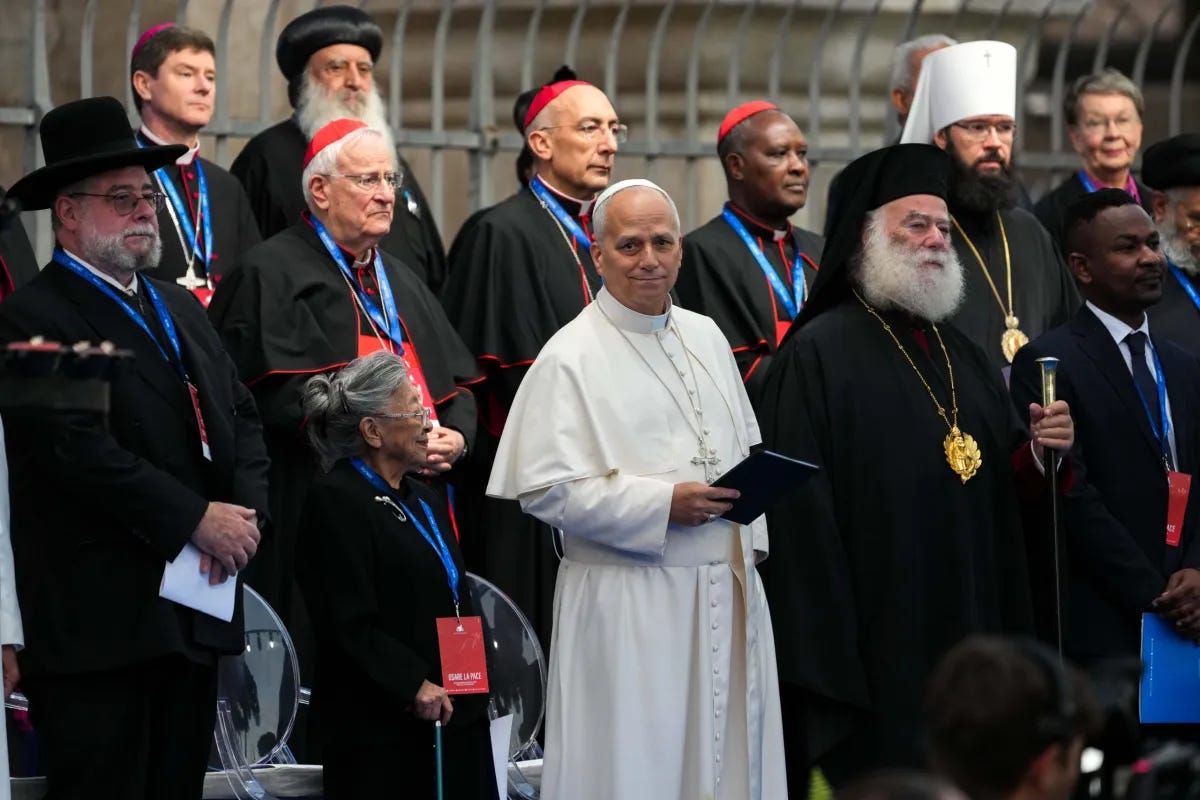
Leo XIV is not only increasingly—and ferociously—beating the drums for so-called “Christian unity,” but now appears to be setting a deadline for his ecumenical fornication project, à la the United Nations’ Agenda 2030.
Christian unity is merely the last inconvenience the Synodalists need to remove in order to fulfill their larger dream of religious unity. After all, a One World Religion would be farcical if the fragmented “Christian” cults cannot even get their own whoring in lockstep.
On January 25, at the conclusion of the Week of Prayer for Christian Unity, Leo XIV delivered a homily that explicitly reiterated the Vatican’s emphasis on ecumenical unity through a synodal path. He declared that “the synodal path of the Catholic Church is and must be ecumenical, just as the ecumenical path is synodal,” and appealed to Christians of other communions to “experience and manifest unity” as a foretaste of Christ’s mission.
If the perennial Catholic faith matters to you at all—and we know it does not to the infestation in the Vatican—then Catholics still associating with the Catholic–Synodal hybrid religion should have grave theological concerns about the practical dangers of merging synodality and ecumenism in the manner Prevost proposes. By no means am I encouraging obstructionism to the reunification of Christendom; however, such unity must always and only take place in fidelity to the Church’s doctrinal integrity, her teaching on the nature of the Church, and the absolute necessity of safeguarding authentic Catholic unity from dilution or confusion.
In other words: unity around Catholic Truth, or no unity at all. Zero compromises can be made in the pursuit of this ideal. Either heretical and schismatic cults return to the One True Faith, or they remain scattered on the road to perdition.
But as we know, the synodal spawn occupying Rome are willing to sell their own mothers to achieve the goal of false ecumenism. A recent example of this moral and doctrinal prostitution was Leo XIV’s omission of the Filioque during the recitation of the Creed with the Orthodox Patriarch.
Modern ecumenical efforts since the Second Vatican Council do not merely carry the latent danger of religious indifferentism—the idea that all Christian traditions (or even religions) are equally valid paths to salvation, a notion expressly condemned by popes such as Pius IX and Gregory XVI—but increasingly appear to have that very error as their end goal.
The homily’s emphasis on shared witness and mutual recognition of baptism grossly overstates what Catholics actually share with other Christian communities. It falsely—and cunningly—suggests that doctrinal differences, particularly on matters as central as the Eucharist, authority, and salvation, are incidental rather than essential. The Council of Trent’s clear teaching that there is no salvation outside the Church has all but vanished in the post–Vatican II era, and whatever fragments of this truth remained are now destined to become mere historical footnotes in the Synodal Religion’s demonic pursuit of institutional unity with Christian sects and other false religions.
By linking synodality and ecumenism, Leo XIV elevates a process into a theological principle. Synodality—listening, sharing experiences, consensus discernment—is presented as co-equal with the Church’s hierarchical nature and teaching office. Yet the Church’s unity is not built by consensus but by adherence to divine truth—an exceedingly inconvenient fact for the synodalists, who are working diligently to bypass it. In its current Vatican usage, synodality emphasizes participation by the laity and even non-Catholic Christians, promoting a mutual “journey together” that deliberately blurs the doctrinal lines that have defined Catholic identity for centuries.
These participatory models, lacking clear doctrinal safeguards, bear no resemblance to the ancient bulwark of divine truth that is Catholicism. Instead, they intentionally—at the behest of Prevost’s globalist taskmasters—imitate modern democratic ideals rather than the apostolic governance Christ established through Peter and the Apostles.
The “pope’s” call to “manifest unity” through joint prayer services encourages Catholics to prioritize external expressions of unity. Unfortunately for the misguided and the ignorant, external unity must be grounded in internal unity of faith and communion—not in shared ceremonies alone. Many non-Catholic traditions openly reject doctrines incompatible with Catholic teaching, including the sacrificial nature of the Mass, the Eucharist as the true Body and Blood of Christ, and the teaching authority of the valid Pope. Leo XIV’s homily treats shared prayer and cooperation as sufficient proofs of unity, thereby short-circuiting the Church’s mission to proclaim truth before fostering outward harmony. Not to mention the fact that praying with heretics and schismatics have always been forbidden by the Church!
The modern ecumenical movement—especially when fused with synodality—systematically diminishes the distinctiveness of Catholic doctrine and sacramental life. It creates a false sense of charity that downplays the necessity of faith and dogma.
When Prevost emphasizes shared witness and co-mission with non-Catholic communions, he knowingly and subtly implies that all Christian witnesses are equally complete. Nothing could be further from the truth. Catholic doctrine—distinct from the doctrines of devils peddled by the Synodal Religion—has always taught that the fullness of truth subsists in the Catholic Church alone. Therefore, unity cannot be reduced to cooperative engagement absent a return to that fullness.
Throughout Church history, visible unity has always been understood as the fruit of shared truth. Councils, creeds, and precise dogmatic definitions preserved unity by clarifying belief. The Synodal Religion’s approach, with its obsession with dialogue, listening sessions, and adaptive consensus, mimics secular coalition-building rather than apostolic orthodoxy. Process replaces doctrine, resulting in a “Church” more interested in agendas than in truth.
This brings us to the final—and most ominous—point: Leo XIV’s explicit reference to the year 2033 as the horizon toward which intensified ecumenical and synodal convergence should advance. The mere act of fixing a symbolic deadline for “unity” should raise serious red flags for Catholics attentive to the signs of the times.
The rhetoric is disturbingly reminiscent of secular globalist frameworks, most notably the United Nations’ Agenda 2030. The post-conciliar “Church” has increasingly functioned as a political actor, trafficking in timelines, milestones, and coordinated global transformation—precisely mirroring the technocratic mindset of contemporary global governance.
Deadlines inevitably generate pressure, and pressure inevitably produces compromise. When unity is treated as a target to be achieved by a fixed date, it ceases to be a gift received from God—who I strongly suspect is not endorsing Prevost & Co.’s brand of unity—and becomes a product manufactured by men. This artificial urgency will suppress doctrinal clarity, marginalize legitimate theological objections, and sideline those unwilling to assent to ambiguity for the sake of appearances. Watch this space.
The Church has already suffered the consequences of “pastoral acceleration” in the post-conciliar era: hastily imposed reforms, unresolved doctrinal tensions, and decades of confusion among the faithful. Chaos was always part of the plan, and imposing a symbolic deadline tied to a major anniversary threatens to export this disorder to a global scale.
Why this date? Who is applying the pressure? Is it coincidence that it aligns so closely with the Agenda 2030 timeline? Are we now being given a schedule for the final phase of an official One World Religion? When will the other false religions be formally brought on board?
The fixed horizon of 2033 will, in all likelihood, usher in the final phase of the Great False Unity: a forced unity of gestures, language, and shared prayer that masks unresolved—and irreconcilable—doctrinal contradictions.
Christ prayed that His followers be one. But the unity promoted in this homily—synodal ecumenism—has nothing to do with Christ’s prayer in John 17. It is neither a clear proclamation of Catholic truth nor a faithful continuation of the Church’s perennial teaching on unity.
Rather than the unity prayed for by Christ, this appears to be the precursor to the unity described in the Apocalypse of St. John, chapter 13:
“And all that dwell upon the earth adored him, whose names are not written in the book of life of the Lamb, which was slain from the beginning of the world…
And he exercised all the power of the former beast in his sight; and he caused the earth, and them that dwell therein, to adore the first beast, whose wound to death was healed…
And it was given unto him to give life to the image of the beast, that the image of the beast should speak, and cause that whosoever would not adore the image of the beast should be slain…”
Our Lady, Co-redemptrix, pray for us…
Our Lady, Mediatrix of all Graces, pray for us…
Viva Christo Rey!
Also Read:
Why do Some Traditional Catholics Think They Can Dine at the Table of Devils?
Excellent article.
Rome has abandoned the catholic faith!
When the Church becomes detestable to the world once again, then I’ll know it has returned to the path it was called to.