

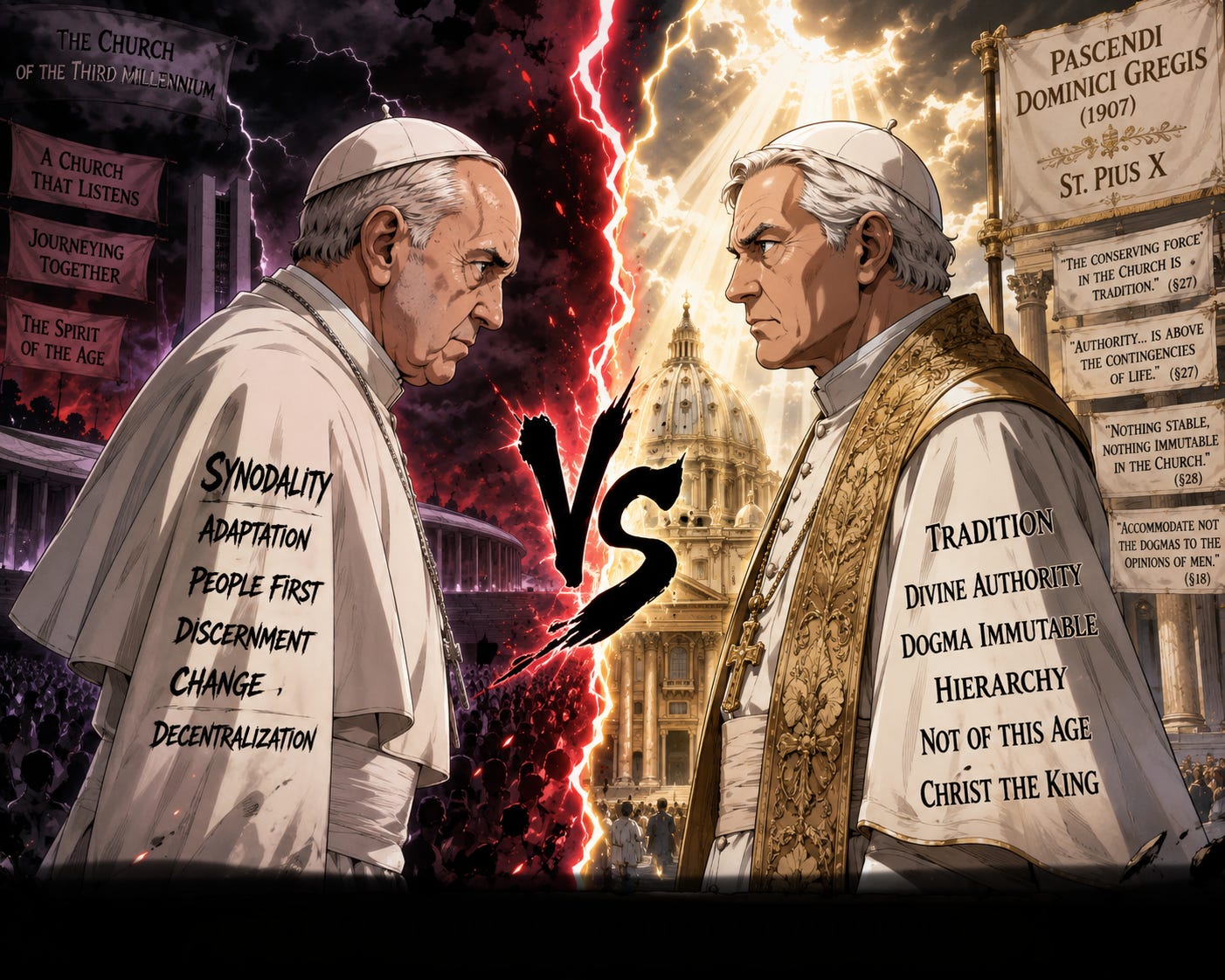
In the maelstrom of fiery opinions in the Catholic world, a recurring theme of late has been the debate over whether a new religion emerged from the Second Vatican Council.
Many commentators, myself included, along with an array of colleagues and a substantial number of clerics and prelates, would argue that it did.
This new religion, or rather heresy, took root long before the dreaded council, but we could say that Vatican II formalized its heretical principles into a new (and false) religion, which was then implemented within the structures of the Catholic Church. This was a brilliant coup that fooled millions. They hijacked the structures, buildings, vestments, and titles of Catholicism while all the time advancing not merely a religion that was not Catholicism, but one whose aim is the destruction of Catholicism and the dethronement of God.
Eventually, this new postconciliar false religion would morph, or rather mature, into its current and most diabolical expression: synodality.
Those who do not take their faith seriously, those who have been duped to the point of being brainwashed, and those who are too horrified to face the truth might dismiss our claims as hysteria, paranoia, or exaggeration. Hence why I approach this subject from every possible angle to prove that more than a billion “Catholics” have been fooled and are currently practicing an alien religion that bears only the title of “Catholicism.”
Radical Fidelity has published dozens of articles and essays arguing, and providing evidence, that the religion flowing from apostate Rome is not Catholicism. Hardly an article is posted here that does not make the claim that synodality is a new and demonically wicked religion.
While many faithful Catholics who read this publication are well versed in the extent of this Spiritual Con to End All Spiritual Cons, many others have only recently been granted the gift of truth and are now eager to learn in order to defend their new, noble, but difficult position. For the sake of the “newcomers”, I want to focus on what I believe was the exact date, moment, and speech in which the enemies of Christ told us they were founding the Synodal Church and its new religion.
In this short essay, we are not only going to pinpoint this moment of infamy, but we are also going to examine several ways in which it proves, once again, that this is a new religion by contrasting it with a great document written by a holy pope and saint.
On October 17, 2015, Jorge Bergoglio, the postconciliar usurper whom the world knew as “Pope” Francis, delivered an address in the Paul VI Audience Hall commemorating the fiftieth anniversary of the Synod of Bishops.
Although Bergoglio had outlined aspects of what the Synodal Church would become at several milestones before this date—such as in Evangelii Gaudium (2013) and in his opening and closing addresses to the Extraordinary Synod on the Family in October 2014—no statement was more explicit or comprehensive than the 2015 address, which is widely regarded as the manifesto of his vision of the satanic religion that would become known as synodality.
Almost immediately after welcoming the attendees, Bergoglio told them (and us) that synodality was born at Vatican II and nurtured throughout the line of postconciliar papal claimants, rather than being some novelty he invented:
“From the beginning of my ministry as Bishop of Rome I intended to enhance the Synod, which is one of the most precious legacies of the Second Vatican Council. For Blessed Paul VI, the Synod of Bishops was meant to keep alive the image of the Ecumenical Council and to reflect the conciliar spirit and method. The same Pontiff desired that the synodal organism ‘over time would be greatly improved.’ Twenty years later, St. John Paul II would echo those sentiments when he stated that ‘perhaps this tool can be further improved.’”
This makes it clear that synodality is the coming of age of the heresy that is the synthesis of all heresies, formalized at the council: Modernism.
Bergoglio went on to state explicitly that this new church would not be one faithful to the perennial teachings of the Catholic Church, but one that would adapt to the world and the times:
“We must continue on this path. The world in which we live and that we are called to love and serve, even with its contradictions, demands from the Church the strengthening of synergies in all areas of her mission. And it is precisely on this way of synodality where we find the pathway that God expects from the Church of the third millennium.”
This is thus no longer the Catholic Church, but a “church” of the times: the “Church of the third millennium”. We will return to this later in the essay.
The whole address was riddled with novel and anti-Catholic statements, but we are going to examine the most prominent deviations from what the popes taught before him by contrasting his address with Pope St. Pius X’s Pascendi Dominici Gregis (1907). This document is probably the papal document par excellence when it comes to the condemnation of Modernism. Hopefully, by the end of this essay, the reader will clearly see that the new religion heralded at the Synod of Bishops in 2015, and which is still practiced by the squatters in the Vatican and those they have misled, is exactly the religion St. Pius X warned us against.
The first contradiction concerns the role of the faithful in the development and discernment of doctrine.
In Pascendi Dominici Gregis, St. Pius X explicitly condemned the Modernist notion that “individual consciences” and the laity become agents of progress within the Church. He wrote that “the conserving force in the Church is tradition, and tradition is represented by religious authority, and this both by right and in fact; for by right it is in the very nature of authority to protect tradition, and, in fact, for authority, raised as it is above the contingencies of life, feels hardly, or not at all, the spurs of progress. The progressive force, on the contrary, which responds to the inner needs lies in the individual consciences and ferments there,” and warned against “that most pernicious doctrine which would make of the laity a factor of progress in the Church” (Pascendi, §27).
Pope St. Pius X thus warned that progressive and liberal ideas are born in the hearts of the laity and that development driven by them would undermine the divine authority of the Church.
Now let us look at how Bergoglio contradicted this directly.
Francis, by contrast, called for the participation of the whole People of God in ecclesial discernment and cited Vatican II, stating that “the whole body of the faithful, anointed as they are by the Holy One, cannot err in matters of belief” (Francis Address, para. 6), before quoting his own almost blasphemous statement in Evangelii Gaudium, where he stressed that “the people of God is holy because this anointing makes [the people] infallible ‘in matters of belief.’”
So, while St. Pius X warned against the faithful becoming a source of doctrinal progress, the heretic Bergoglio not only called for exactly the opposite, but went on to call the people “infallible in matters of belief.”
The second area of clear contradiction concerns the structure of ecclesiastical authority.
In §23 to §25 of Pascendi, St. Pius X rejected the Modernist proposal that authority should derive from the collective consciousness of believers or be expressed through democratic mechanisms.
He wrote that the Modernists held that “authority emanates vitally from the Church itself” and is therefore “subject to” the religious consciousness of the faithful, concluding that “the ecclesiastical authority should shape itself to democratic forms” (Pascendi, §§23–25).
The saintly pope clearly condemned these ideas as completely incompatible with the Catholic understanding that the Church received its authority from Christ.
Again we see that Bergoglio, in announcing the new church and new religion, went in exactly the opposite direction. He advocated a participatory model of governance in which the Church “journeying together—laity, pastors, the Bishop of Rome” is the fundamental principle (Francis Address, para. 5).
He then doubled down by defining the Synodal Church as “a Church which listens,” in which “the faithful people, the college of bishops, the Bishop of Rome: all listening to each other” (Francis Address, para. 8), and presented mutual listening as a defining characteristic of ecclesial authority (Francis Address, para. 9).
Once again, we see that Francis’ new synodal religion completely contradicts St. Pius X’s warning that the sinful sentiments of the faithful could never become the source of authority.
Our third point of divergence concerns institutional development within the Church.
In Pascendi, St. Pius X repeatedly attacked the Modernist theory that the Church, its doctrine, and its institutions must evolve according to the changing needs of history. He succinctly summarized the Modernist position in his statement that for the Modernists “in a living religion everything is subject to change, and must change, and in this way they pass to what may be said to be, among the chief of their doctrines, that of Evolution. To the laws of evolution everything is subject—dogma, Church, worship, the Books we revere as sacred, even faith itself, and the penalty of disobedience is death” (Pascendi, §26).
Going to the dark heart of the matter, he then concluded that “for the Modernists, both as authors and propagandists, there is to be nothing stable, nothing immutable in the Church” (Pascendi, §28).
In his address, on the other hand, Bergoglio made no bones about the fact that the new religion would be a permanent project of “improvement.”
Referring to Paul VI’s original institution of the Synod, he said that it was always expected that “the organization of the Synod could ‘be improved upon with the passing of time,’” and concluded, “We must continue along this path” (Francis Address, paras. 4–5).
As though no Catholic Church or Catholic religion had existed prior to the Second Vatican Council, Bergoglio then called, with great audacity, for renewed reflection on intermediary structures of collegiality and admitted that “we are still on the way,” advocating “a sound ‘decentralization’” (Francis Address, para. 18).
This notion of “still on the way” is, of course, a hallmark of any revolution: perpetual change for the sake of change so that no objective truth remains.
Bergoglio might have been discussing institutional development here, but later, with greater and greater frequency, this mentality would filter into doctrine and other matters as well. Needless to say, this was once again in direct opposition to St. Pius X’s warnings about doctrinal evolution.
Our fourth and final piece of evidence that proves a new religion was announced on this occasion in 2015 concerns the question of how the Church should respond to contemporary circumstances.
Throughout this tour de force against Modernism, Pope St. Pius X repeatedly condemned attempts to adapt ecclesiastical structures or teaching to the spirit of the age. He argued that the Modernists “continuously and openly criticize the Church because of her sheer obstinacy in refusing to submit and accommodate her dogmas to the opinions of philosophy; while they, on their side, after having blotted out the old theology, endeavor to introduce a new theology which shall follow the vagaries of their philosophers” (Pascendi, §18).
Without a doubt, St. Pius X recognized the grave danger that accommodation to the intellectual currents of the age would ultimately threaten the integrity of the faith.
But along came Bergoglio and his “Church of the third millennium,” once again going exactly where St. Pius X warned they should not go.
Under the guise of the ever-convenient “pastoral necessity,” Bergoglio deceived the audience with his claim that “The world in which we live and that we are called to love and serve, even with its contradictions, demands from the Church the strengthening of synergies in all areas of her mission. And it is precisely on this way of synodality where we find the pathway that God expects from the Church of the third millennium” (Francis Address, para. 5).
With utter disdain for how God structured authority in His Church, the usurper Bergoglio then argued that “it is not appropriate for the Pope to replace the local Episcopates in the discernment of all the problems that lie ahead in their territories. In this sense, I feel the need to proceed in a healthy ‘decentralization’” (Francis Address, para. 18).
With these and many other statements in the address, it is clear that Bergoglio defined the new church and religion by the very adaptation to contemporary conditions that St. Pius X sternly warned against.
The reader would do well to read Bergoglio’s address in full, for it is a concise blueprint for the new church and its false antichrist religion. In it, he employs every synodal catchphrase and perversion that have by now driven faithful Catholics to nausea.
Most importantly, by comparing this address not only to St. Pius X’s Pascendi, but to preconciliar Catholic teaching as a whole, it once again becomes evident that anyone denying that Vatican II is advancing a satanic new religion is either ignorant, lazy, naïve, or dishonest.
Unfortunately, none of the above will be a good enough excuse on Judgment Day.
A HUMBLE APPEAL TO MY READERS!
At the end of each month, I make this same request because the reality behind Radical Fidelity has not changed: countless hours of research, reading, writing, editing, and correspondence go into producing this work. What began as a side endeavor has steadily become a full-time apostolate, demanding more time, energy, and resources with each passing month.
I am also grateful to share that additional articles of mine are now appearing at Integrity Magazine. While this means even more free content for readers, it also means a heavier workload spread across multiple platforms.
Despite this, I remain committed to keeping my work outside paywalls. I firmly believe that truth, especially in these times, should remain accessible to everyone regardless of financial means.
If Radical Fidelity has informed, encouraged, challenged, or benefited you in any way, please consider supporting this apostolate through either a monthly contribution or an occasional donation of any amount. Your support helps make possible not only the continued growth of this small but meaningful community of faithful Catholics, but also the work still to come:
And if you missed any articles this month, here they are all in one convenient place to be read, reread, and shared. There is also a link at the end to my work published at Integrity Magazine:
Radical Fidelity:
Cupich Confirms Priorities of False Church and Accuses Faithful Catholics of Tearing its Unity
What the Heart is Full Of: Analysis of Word Frequency in New Synodal Document Reveals the Truth
The Serious Implications of Legitimizing a False Pope
If the Synodal Church Didn’t Have Double Standards, It Would Have No Standards at All
Synodal Shambles Continue While Leo XIV Celebrates “Integral Human Development”
Synodal Church’s Credibility Further Down the Toilet as Rupnik is Allegedly Acquitted
Drama Continues as SSPX Files Canonical Recourse Against Vatican Decree
The Death of the “Pastoral Council” Argument and Its Serious Implications
Do Not Fall for the Coming TLM Deception
Dear Trad Inc., About that Procedure of Reconciliation...
Vatican Declares Excommunications Following SSPX Episcopal Consecrations
Don’t hesitate to check out my other work at Integrity Magazine HERE
Our Lady, Co-redemptrix, pray for us…
Our Lady, Mediatrix of all Graces, pray for us…
Viva Christo Rey!
Since when in history has the Church changed the TRUTH to accommodate the world? If it did beginning in the 1st century we would all be worshipping Roman gods. Just toss a pinch of incense to appease the gods and we won’t torture you to death.
Never!
And are Novus Ordo Catholics all stupid or simply deceived or simply don’t care? Ummm? All three. The narrow path versus the wide path? The wide path has always been appealing to the world.
"anyone denying that Vatican II is advancing a satanic new religion is either ignorant, lazy, naïve, or dishonest."
And there it is.....Gaspars Matt and Marshall.