

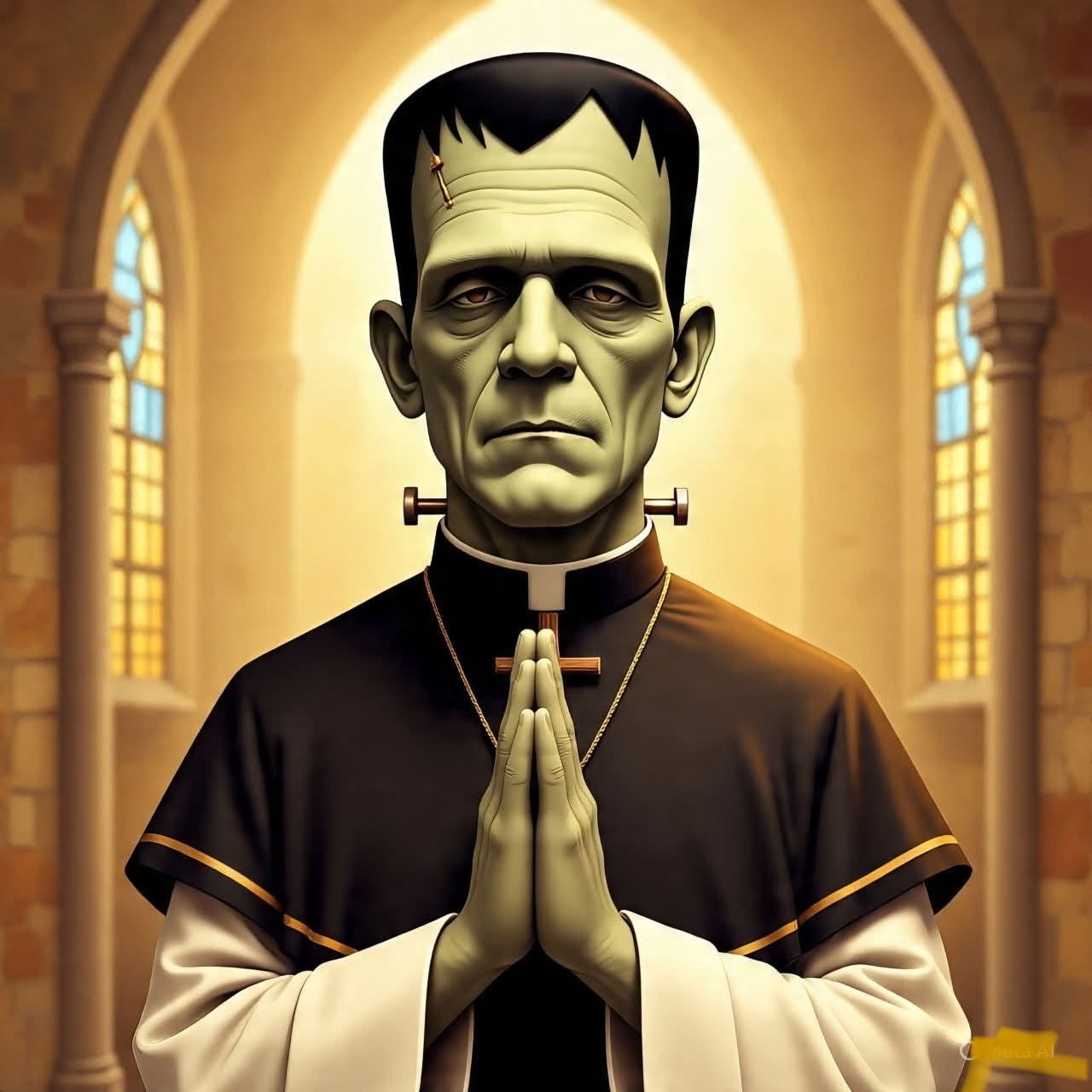
An article which appeared on LifeSiteNews this weekend titled “Schism fears arise as Catholic Church in Germany aims to put laity on ‘same level’ as bishops” begins as follows:
“As Pope Leo XIV meets with his Apostolic Nuncio for Germany, Monsignor Nikola Eterovic, on Saturday, the very real possibility of schism with the Catholic Church in Germany looms.
‘It’s alleged the German Church wants to put the German laity on the same level as the bishops and also let them control the cash,’ according to a report in the Italian-language publication Il Giornale by Nico Spuntoni.”
What is unfolding is not simply another national dispute over pastoral policy or ecclesial administration, but the completion of a new ecclesial body—stitched together from democratic ideology, sociological theories, and doctrinal dissent. It is, quite literally, the Frankenchurch.
The reader will have to keep his wits about him though, and understand that the German “church” is not edging dangerously close to schism with the Roman Catholic Church, but in fact toward schism with the heretical Synodal Religion that has illegally entrenched itself like a parasite within the structures of the true Church, and is itself in schism with Eternal Rome. What we are seeing is the inevitable result of modernist synodalism. Because the usurpers have been defecting from the true faith for more than sixty years, there could be no outcome other than endless schism upon schism. In the end, the best they can aim for is a loosely related family of “faith communities” united only—wrongly—under the name “Catholic Church.” It currently bears little resemblance to the true Catholic faith, and in the future it will resemble it even less.
Germany’s experiment is not an aberration but the logical flowering of a false principle now being promoted across the Catholic world under the banner of “synodality.” Like all revolutions within the Church, it advances in stages: first ambiguity, then pressure, then structural change, and finally open rupture—not only with the true Catholic Church but even with the Synodal Religion infesting the Church’s structure.
I know it is confusing but remember who is the ultimate master of this new religion: the prince of lies and the author of confusion.
From Synodal Path to Schism Path
When the German Bishops’ Conference joined forces with the lay-dominated Central Committee of German Catholics in December 2019 to launch what they called the Synodal Path, Modernist Rome (the Synodal Church) was assured that this would be nothing more than a temporary consultative exercise—a pastoral conversation meant to address the fallout of the abuse crisis and restore credibility to a wounded Church.
Boy, how wrong could you be.
From its inception, the project carried within it the seeds of something far more dangerous and predictable. What Germany initiated was not a synod in the Catholic sense, but the beginning of a parallel ecclesial structure—a church within the (Synodal) Church, gestating under the language of reform.
Almost immediately the process shifted from discussion to resolution, and from resolution to ideological mandate. The assemblies quickly moved beyond abuse and governance into territory directly contradicting Catholic doctrine and the sacramental constitution of the Church. By 2023, texts had been approved calling for the blessing of same-sex unions, the normalization of gender ideology in ecclesial life, renewed agitation for women in sacramental ministries, open questioning of priestly celibacy, and the redistribution of governing authority away from bishops toward lay committees. These were not exploratory proposals. They were votes aimed at remaking Catholicism according to contemporary social theories.
Yet even these doctrinal ruptures were only the preliminary stage. The true revolution now unfolds in 2026, as German leaders push to establish a permanent Synodal Conference—a body in which bishops and laity would exercise equal legislative authority over matters touching doctrine, discipline, and finances. Such a structure would not merely advise bishops but bind them. Authority would no longer flow from apostolic succession but from majority vote. The bishop, instituted by Christ as successor of the Apostles and guardian of the deposit of faith, would become a delegate accountable to an ecclesial parliament.
Germany now stands not simply at the edge of schism but at the threshold of creating a church whose governing principles are incompatible with Catholic ecclesiology. Once doctrine becomes subject to regional voting blocs, unity with Modernist (Synodal) Rome ceases to be a lived reality and survives only as a legal fiction. A church that legislates truth by majority is no longer Catholic even by the synodalists standards—though it is unclear why the synodalist hierarchy would object, since this is synodality in all its glory.
The German experiment reveals the essential fate of synodality: eventually it becomes indistinguishable from the Protestant principle that shattered Christendom five centuries ago. Protestantism began by transferring authority from the apostolic office to assemblies guided by local conscience. The predictable result was fragmentation without end—a multiplication of denominations, each claiming legitimacy, none preserving unity. Germany is now reenacting this drama within “Catholic” structures. Authority once grounded in sacrament is being relocated to committees, and doctrine is treated as negotiable.
The so-called Synodal Path has thus revealed its true identity: not a path toward renewal, but a Schism Path leading ever further from Eternal Rome and toward the Protestantization of Catholic governance. Now that such a model is tolerated, the precedent invites imitation everywhere. What is being assembled in Germany is not merely a local aberration, but a blueprint for endless ecclesial fragmentation.
Chaos by Design
To be fair, Germany did not invent synodalism. It simply took the principle promoted by the New Religion in Rome seriously and followed it to its natural conclusion. The problem is not that the Germans went “too far.” The problem is that synodality itself contains the seeds of dissolution.
When governance is reimagined as “listening” rather than teaching, and authority becomes negotiable—something to be discussed as though it were a product of consensus rather than divine revelation—the Church’s supernatural constitution is undermined. Synodality invites the laity not to assist the shepherds, but to judge and reshape them. Once that door is opened, no theological boundary remains intact.
Realizing They Can’t Have Their Cake and Eat It
The greatest irony is Cardinal Grech’s report to the recent consistory, in which he reminded the Cardinals of the Synodal Church that “it is always up to the Bishop of Rome to suspend the synodal process if necessary.”
They have created a monster, unleashed it, and now want to lure it back into its cage. Too late. This exposes the central paradox: synodalists demand decentralized authority while appealing to Rome when convenient. They reject hierarchical oversight yet insist their innovations remain Catholic.
They attempt the impossible—to wield the language of communion while dismantling its structure. They invoke synodality to override bishops, then invoke papal legitimacy to shield themselves from correction. Synodality is nothing but a tool for institutionalizing dissent under ecclesial cover.
Germany is the inevitable outcome of that contradiction, and it will not be the last. Spain already hints at following the same path. Once synodality is elevated above obedience, it devours the very authority it claims to serve—even the Synodal Religion now ruling Rome.
Synodality will eat itself.
Benedict XVI Warned but Was Ignored
The article in Il Giornale, on which LifeSiteNews bases their own, reported that long before the present rupture loomed, Benedict XVI saw clearly where this path would lead.
In 2021 he allegedly privately warned Cardinal Marx that the German process would “do harm and end badly” if it were not stopped. That judgment was theological and not political. Ratzinger understood that once a local Church treats doctrine and structure as negotiable, separation from Rome becomes only a matter of time.
His warning was dismissed. Worse, he was publicly undermined in Germany during the height of the controversy—a symbolic rejection of the last “defender”, albeit modernist, of Catholic continuity in that land. Even Benedict recognized what many still refuse to admit: synodalism is slow-motion schism.
A Monster Born of Synodality
What now emerges in Germany is neither Catholic nor honestly Protestant, but something grotesquely hybrid: a church that retains Catholic names while rejecting Catholic substance. Its marks will be a hierarchy stripped of authority, morality rewritten to suit the world, doctrine decided by committee, and unity maintained only by money and bureaucracy.
In other words: welcome to the Frankenchurch—assembled from the corpse of Catholic structure and animated by the electricity of modern ideology and synodality.
Germany is not an anomaly but a preview of what awaits all who have embraced this whoredom of apostasy.
Our Lady, Co-redemptrix, pray for us…
Our Lady, Mediatrix of all Graces, pray for us…
Viva Christo Rey!
Also Read:
The Synodal Religion’s Most Dangerous Denial
Ten Reasons Why Cardinal Roche’s Document is Only Good for Lining Your Parrot Cage With
They can leave or form their own church but they and the synodal religion should not retain the title “Roman Catholic Church”. This deception and lie has done great harm. Traditional and faithful Catholics need to stop deceiving themselves that this, Synodal religion, is still the Catholic Church. It is not and to pretend it is will lead to the second dismantling of Tradition within this false edifice. Remembering that the TLM (Traditional Church and Faith) was dismantled under JPII and resurrected under BXVI.
I can’t find it now, but somewhere s few years ago, I remember this quote from a German bishop: “We want to be Catholic - differently”.
There’s already one German Protestant denomination (Lutheranism), and it appears we are on track for a second one.