

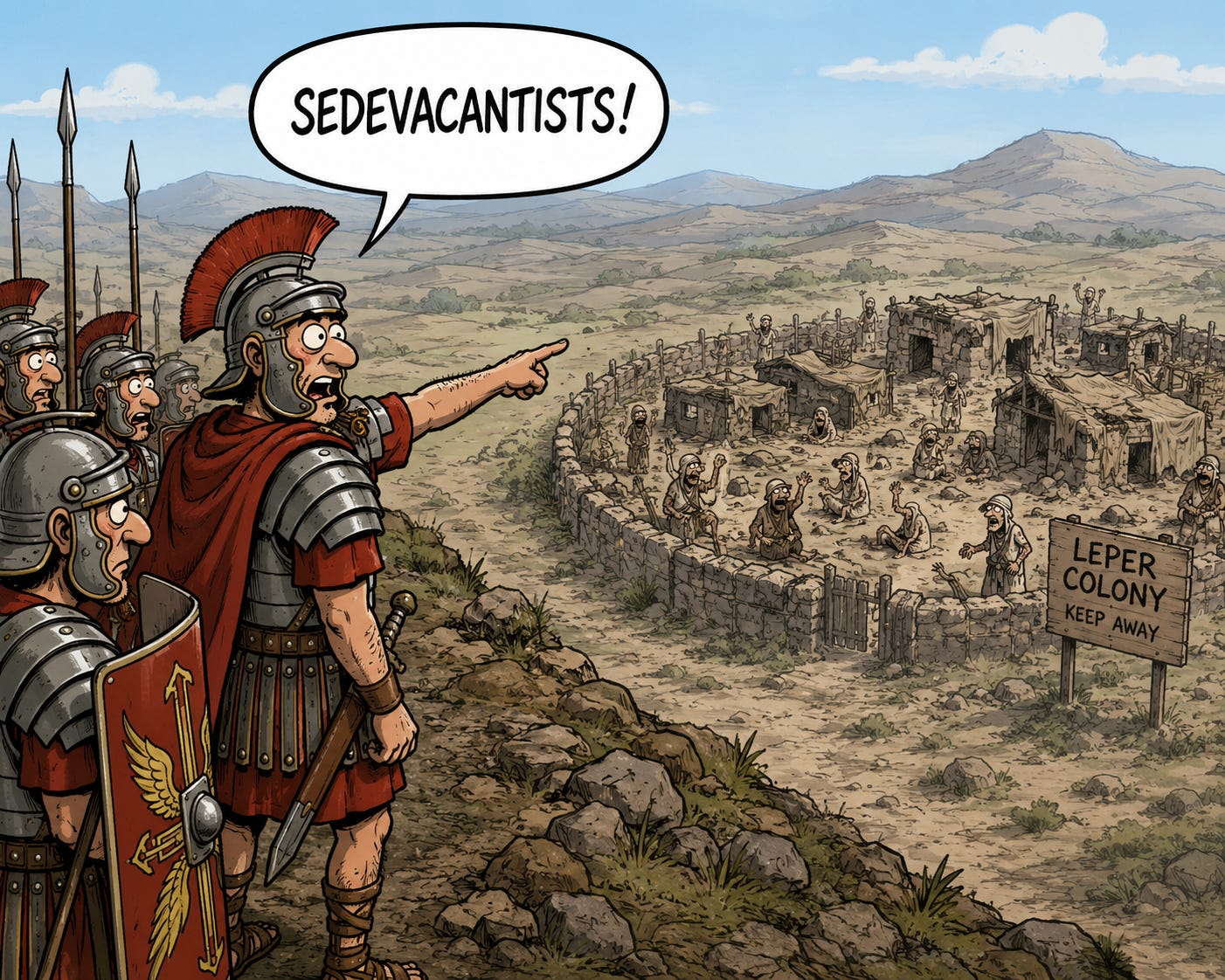
Out there in Synodal “Trad” land where the wild heresies grow tall, a great comedy duo—in the tradition of Key & Peele, Laurel and Hardy, and Abbott and Costello—freely roams the countryside under the guise of being Catholic commentators.
For the sake of avoiding polemics, I will not name them. But I would like to note something at the outset of this two-part essay [Part 2 here]. One half of said comedy duo, whose material mostly centers around attacking sedevacantists—or whoever they perceive as such—called sedevacantists “autistic” on X a few months ago.
Of course, every man has a right to his opinion, however ill-informed it may be, but I did find the “autistic” slur slightly ironic, as the other half of the duo has an obsession with the following question: if there is no pope, then where is the Church?
This is indeed a very valid question if no one has volunteered an answer, but less so if the person asking it has been answered multiple times and in multiple ways.
So, for the sake of the comedy duo, as well as those who sincerely ask me this question, I will try to (again) give a simple answer.
I also want to reiterate once again that I am not very fond of labels, as I simply want to be known as a God-fearing Catholic; unfortunately, here in the late stages of Modernist apostasy, labels are helpful. But, for the sake of sensitive souls, I will throughout the essay try my best to use the dreaded S-word as little as possible.
This essay will hopefully be helpful to those who are finally recognizing that there is no pope, or that there is a false pope, an anti-pope, or a usurper in the Vatican. How you choose to word your conclusion is merely semantics. What is important—and what you need to thank Almighty God for—is that He has removed the spiritual blindness, and that you can finally proclaim in great peace: the postconciliar popes cannot be real popes, and the postconciliar religion is not Catholicism.
Now on to that question.
The most common objection raised when stating there is no pope or then a usurper in the Seat of Peter, is not the question of whether the Second Vatican Council introduced novelties, nor whether the postconciliar hierarchy has promoted doctrines and practices at variance with previous Catholic teaching. Rather, it is a more fundamental ecclesiological question. If the Holy See is vacant, and if those occupying the Vatican profess a religion in total contradiction of historic Catholicism, then where is the Church founded by Jesus Christ?
The question deserves to be taken seriously because it touches upon several dogmas concerning the nature of the Church. Catholics are required to believe that the Church is one, holy, catholic and apostolic. They are also bound to believe that the Church is visible, perpetual and indefectible. Christ did not establish an invisible fellowship of believers but a visible society endowed with authority, sacraments and hierarchy.
Consequently, any explanation of the present crisis must account for these essential characteristics. It is not sufficient merely to argue that the conciliar hierarchy has departed from Catholic tradition. One must also explain how the Church continues to exist as the visible Mystical Body of Christ.
This question is often misunderstood because it is framed incorrectly. Critics frequently ask where the Church has “gone,” as though the Church were required to coincide at every moment with the officials occupying the Roman Curia or the buildings of Vatican City.
Classical Catholic ecclesiology, however, does not define the Church by geography or by the possession of ecclesiastical property. Rather, it defines the Church by the profession of the true faith, the lawful administration of the sacraments, and legitimate ecclesiastical authority. The present controversy concerns whether those claiming authority in Rome continue to possess that authority. It does not concern whether the Church herself has ceased to exist.
Every serious “the-Seat-of-Peter-is-empty/ usurped” argument begins with several theological principles that are not peculiar to sedevacantism itself. They belong to the ordinary teaching of the Catholic Church.
The first is the doctrine of indefectibility. Christ declared to St. Peter, “Upon this rock I will build my Church, and the gates of hell shall not prevail against it” (Matthew 16:18). Likewise, before His Ascension He promised His Apostles, “Behold I am with you all days, even to the consummation of the world” (Matthew 28:20). These promises have consistently been understood to mean that the Church cannot fundamentally defect from the faith entrusted to her by Christ. She may endure persecution, corruption among her members and even widespread apostasy, but she cannot officially teach error as the rule of faith for the universal Church.
This principle is repeatedly affirmed in the papal magisterium. Vatican I taught that the Church possesses perpetual stability because of Christ’s promises. Pope Leo XIII, in Satis Cognitum, described the Church as a perfect society whose essential constitution cannot fail. Pope Pius XII, in Mystici Corporis Christi, taught that the Church is the Mystical Body of Christ, animated by the Holy Ghost and incapable of becoming another religion.
Whatever one concludes about the present crisis, these principles remain non-negotiable.
Closely related to indefectibility is the doctrine of visibility. The Church is not merely an invisible collection of sincere believers. She is a visible society whose members may be identified by objective characteristics. This point is repeatedly emphasised by St. Robert Bellarmine in De Ecclesia Militante. Against Protestant claims that the Church had become invisible, Bellarmine famously argued that the Church is “as visible and palpable as the Kingdom of France.” The comparison is significant. A kingdom remains identifiable because it possesses objective characteristics, not because every citizen is virtuous or every official is faithful.
Pius XII likewise insisted that the Church is a visible body governed by legitimate pastors. Membership is not determined by subjective spirituality but by visible profession of the Catholic faith, participation in the sacraments and submission to lawful ecclesiastical authority. Consequently, any explanation of the current ecclesiastical crisis must preserve this visibility. If the Church survives merely as an invisible collection of isolated believers, then Catholic ecclesiology has been abandoned.
A third principle frequently invoked by those defending a no-pope position concerns the status of public heretics. Long before the Second Vatican Council, Catholic theologians discussed whether a manifest heretic could remain a member of the Church. Although they differed regarding the precise mechanism by which ecclesiastical office would be lost, they agreed that public heresy is incompatible with membership in the Church.
St. Robert Bellarmine states the matter with remarkable clarity. “Manifest heretics are not members of the Church, that is certain.” Elsewhere he argues that a manifest heretic cannot be Pope because one who is not a member of the Church cannot be its head.
St. Francis de Sales makes essentially the same argument, observing that those outside the Church cannot govern the Church. Pope Leo XIII likewise teaches in Satis Cognitum that separation from the Church excludes a person from her authority as well as her communion.
These authorities do not in themselves prove the empty-seat thesis. They establish only the theological framework within which the thesis is argued. The central claim is that the doctrinal changes associated with the postconciliar hierarchy constitute public adherence to teachings incompatible with Catholic faith. If that premise is accepted, many empty-seaters conclude that those publicly professing such doctrines cannot possess ecclesiastical jurisdiction. Whether one accepts that conclusion is a separate question, but the theological principles upon which the argument rests are not novel inventions.
The real difficulty therefore lies elsewhere. If the Church cannot defect, if she remains visible, and if manifest heretics cannot govern her, how is the Church to be identified during a prolonged vacancy of the Apostolic See?
Among those claiming the seat is empty or has been occupied by an usurper, there is no universally accepted answer. All agree concerning the fundamental principles. They differ regarding the precise explanation of how the Church’s visibility is preserved under present circumstances. These differences should not be exaggerated, as they merely represent distinct theological opinions concerning an unprecedented historical situation. (Which by the way makes the “sedevacantism is a novel unprecedented position” argument so silly. Yes, we know, because we are facing an unprecedented cataclysmic crisis. So stop it already.)
The most common explanation may be described as the remnant thesis. According to this view, the Church continues to exist wherever the Catholic faith is publicly professed, the traditional sacraments are validly administered, and bishops and priests preserve apostolic succession. The Church has become extraordinarily small, but she has not become invisible.
Advocates of this position frequently appeal to Sacred Scripture. Christ repeatedly warned that false prophets would arise and deceive many. In St. Luke’s Gospel He asks, “When the Son of Man cometh, shall he find, think you, faith on earth?” St. Paul speaks in the Second Epistle to the Thessalonians of a great apostasy preceding the revelation of the man of sin. These passages do not explicitly predict the present crisis, nor do they constitute direct proof of sedevacantism. Nevertheless, they establish that Scripture contemplates periods during which genuine faith may become exceedingly rare without ceasing altogether.
The Fathers of the Church occasionally express similar expectations. St. Augustine speaks of a time when the faithful appear to be reduced to very small numbers. Other Fathers describe the final trials of the Church in language suggesting that external triumph should not be expected immediately before the end of history. These texts are not interpreted as dogmatic prophecies concerning the twentieth century. Rather, they are employed as illustrations of a principle. Numerical smallness does not imply ecclesiological nonexistence.
Historical precedent is also invoked. During the Arian crisis, St. Athanasius lamented that the majority of bishops had succumbed to heresy or ambiguity. Although the famous phrase, “They have the churches, we have the faith,” is more a summary of his thought than a direct quotation, it accurately reflects his conviction that truth rather than institutional dominance ultimately identifies the Church. Athanasius never denied the visibility of the Church, but neither did he identify visibility with numerical superiority or political recognition.
From this perspective, the Church remains visible because she continues to possess objective marks. Catholics publicly profess the ancient faith. Priests publicly celebrate the traditional liturgy. Bishops continue apostolic succession through valid episcopal consecration. The Church therefore exists as a recognizable society even though she lacks the ordinary exercise of universal government from Rome.
Critics often respond that this explanation reduces the Church to scattered groups of believers lacking unity or central authority. Defenders of the empty-seat variety of claims generally answer that visibility does not require worldwide administrative efficiency. During every papal interregnum the Church continues to exist despite the temporary absence of her visible head. The present situation is extraordinary because of its duration, not because the Church is incapable of surviving without an immediately recognized Roman Pontiff.
Whether this answer is ultimately satisfactory remains a matter of debate even among “no-popers” themselves. It nevertheless represents the position most commonly encountered in traditional Catholic publications and forms the foundation upon which several other explanations are built.
To be continued…
Our Lady, Co-redemptrix, pray for us…
Our Lady, Mediatrix of all Graces, pray for us…
Viva Christo Rey!
Also Read:
Drama Continues as SSPX Files Canonical Recourse Against Vatican Decree
The Death of the “Pastoral Council” Argument and Its Serious Implications
"the Church continues to exist wherever the Catholic faith is publicly professed, the traditional sacraments are validly administered, and bishops and priests preserve apostolic succession. The Church has become extraordinarily small, but she has not become invisible."
The hard narrow path. Not the wide straight easy one. I have found Catholicism to be demanding of effort and persistance. You've got to want it and seek it.
“During every papal interregnum the Church continues to exist despite the temporary absence of her visible head. The present situation is extraordinary because of its duration, not because the Church is incapable of surviving without an immediately recognized Roman Pontiff.” This is the keystone for empty seaters! Excellent, thank you for initiating this series of posts!!