
Would You Support This Controversial Solution for the Crisis?
Whatever one’s judgment of the proposal, it is difficult to deny that it reflects a broader shift within traditionalist Catholicism from critique to seeking actionable solutions.

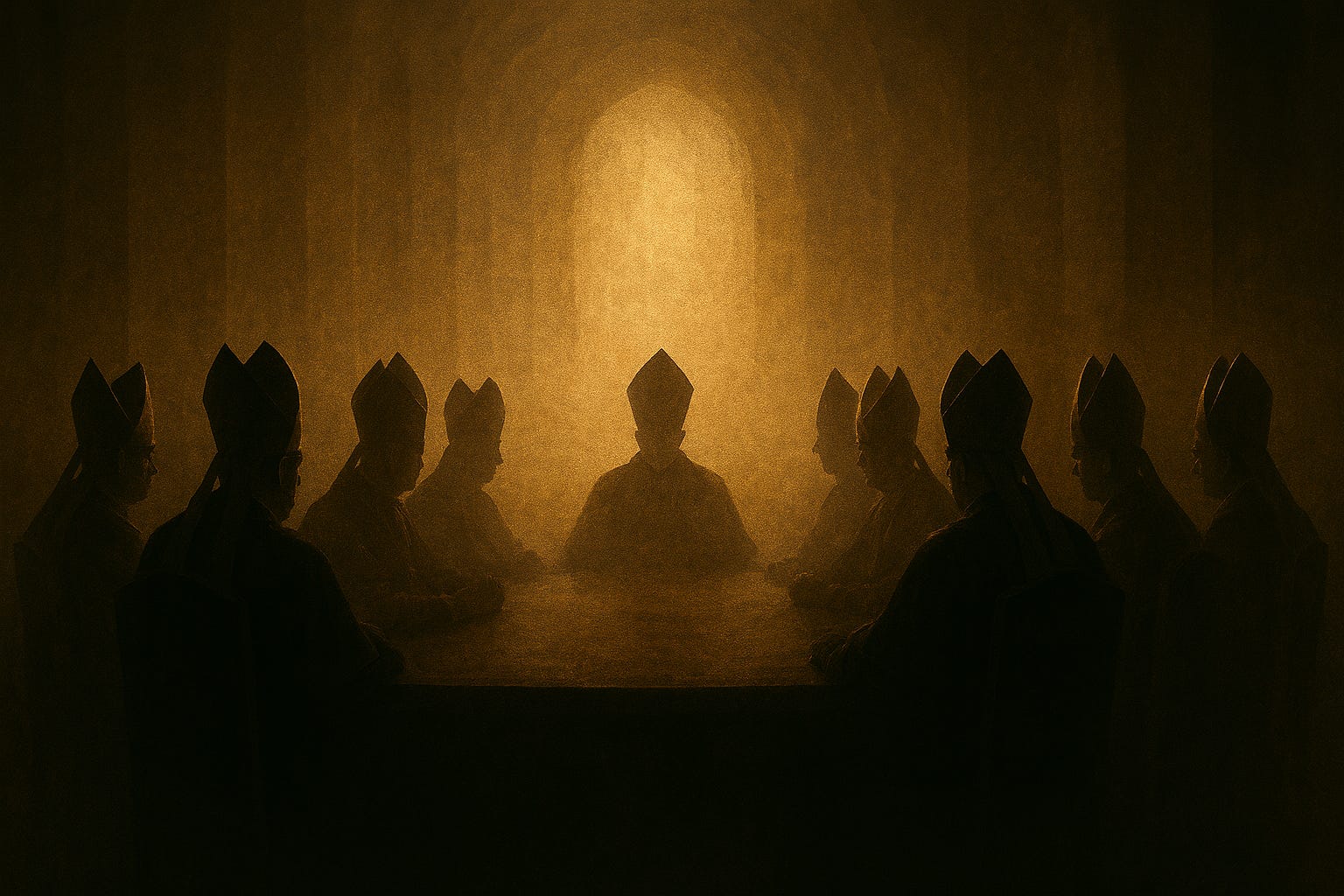
(As I often find myself having to do, I need to begin this article with a disclaimer, as I am certain I will receive criticism from all sides. On the one hand, I will be accused of promoting schism and sedevacantism. On the other, sedevacantists will accuse me of not supporting their position enthusiastically enough.
Be that as it may, I want to be clear that I am merely publishing this information as a journalist in order to stimulate discussion. I am therefore neither promoting this initiative nor condemning it. I would genuinely like to hear from my readers in the comment section. Would you support this initiative, or would you reject it? Why? What arguments would you advance? What dangers do you perceive? Do you have alternative suggestions? Do you have more information about the agents behind the initiative?
Let me know.)
In a time when many of the faithful perceive the Catholic Church to be undergoing one of the, if not the, gravest crises in her history, a “new” initiative has emerged from among traditionalist circles: a call for what is termed an “Imperfect General Council.”
Hosted on the website Unam Sanctam, this effort represents not merely another critique of the post–Vatican II Church, but a concrete proposal, albeit a controversial one. It is an appeal to the hierarchy itself to confront what is seen as a fundamental rupture at the very summit of ecclesiastical authority.
The initiative stands at the intersection of theological speculation, historical precedent, and urgent practical concern. It seeks to articulate a path forward where, in the eyes of its proponents, the ordinary mechanisms of Church governance have broken down. To understand its significance, one must consider not only its proposal, but also the diagnosis of the crisis that gives rise to it.
The starting point of the initiative is the conviction that the Catholic Church has, since the Second Vatican Council, entered into a condition of profound disorder. This disorder is not described merely in terms of liturgical experimentation or pastoral confusion, but rightly as a crisis touching doctrine, authority, and identity itself.
According to the material presented on the site, the post‑conciliar period represents not a legitimate organic development, but a rupture. The language used is stark and echoes my own sentiments. It speaks of “modernists” establishing what is effectively a new religion under Catholic forms, one that departs substantially from the perennial teaching of the Church. This perspective places the initiative squarely within the broader current of radical traditionalism and, at least implicitly, within the orbit of sedevacantist thought.
Interestingly, the initiative does not insist on a single conclusion as a prerequisite. Rather, it frames the situation as one in which the legitimacy of the current hierarchy, especially the papacy, must be seriously examined. The faithful, it argues, are confronted with a situation in which obedience can no longer be presumed to be straightforward, because the object of that obedience is itself in question.
This sense of an unresolved and escalating crisis provides the immediate context for the proposal of an imperfect council.
The central concept advanced by the initiative is that of an “Imperfect General Council.” Though unfamiliar to many Catholics today, the term has roots in classical ecclesiology. It refers to a gathering of bishops that lacks the formal convocation of a pope and therefore does not possess the full juridical status of an ecumenical council.
Historically, theologians entertained the possibility of such a council in extraordinary circumstances, particularly in cases where the papacy itself was doubtful, vacant, or compromised. The initiative draws upon this tradition and seeks to revive it as a practical solution to the present situation.
The purpose of such a council, as envisioned by the organizers, would not be to legislate new doctrines or impose novelties, but to address the most fundamental question facing the Church, namely whether the current claimants to the papacy are in fact legitimate. From this determination would follow a resolution regarding how a true pope might be recognized or elected.
In this sense, the proposal is both radical and conservative at once. It is radical because it contemplates action without papal authorization. It is conservative because its ultimate aim is the restoration of normal order, specifically the clear and undisputed authority of a true Roman Pontiff.
Underlying the proposal is a theological principle of considerable importance, the idea that the Church, as a divine institution, cannot be deprived of the means necessary for her own preservation. If the ordinary structures of authority become uncertain or defective, then extraordinary measures must be possible.
The initiative argues that the laws governing papal elections, while authoritative, are not immutable in every conceivable circumstance. Ordinarily, the election of a pope belongs to the College of Cardinals. But if the legitimacy of the cardinals themselves is in doubt because of questionable ordinations, heterodox beliefs, or invalid appointments, then the normal mechanism is rendered unreliable.
This creates what might be called an ecclesiological deadlock. If no unquestionable authority exists to elect a pope, and yet a pope is necessary for the visible unity of the Church, the question arises as to how the impasse can be resolved.
The proposed answer is that the bishops of the Church, as successors of the Apostles, retain a residual authority that can be exercised in such a crisis. An imperfect council would serve as the organ through which this authority is expressed.
One of the most notable features of the initiative is that it appears to originate not from bishops or theologians of established standing, but from the laity. The open letter at the center of the project is presented explicitly as a plea from lay Catholics to their pastors. That said, one source told me that “Bishop Pierre Roy, Bishop Rodrigo da Silva, Frei Tiago, and others are part of this.” Bishop Roy has, of course, on numerous occasions since last year publicly argued for such a council, including on platforms such as Stephen Kokx’s Trad Watch.
The initiative is not without precedent. Catholic tradition recognizes that the faithful, as a whole, possess a sensus fidelium, a supernatural instinct for the truth of the faith. In times of crisis, this instinct can manifest itself in a recognition that something is gravely amiss, even when the hierarchy appears silent or divided.
The authors of the initiative are careful to maintain a posture of humility. They do not claim authority to resolve the crisis themselves. Rather, they present themselves as petitioners, urging those who do possess authority, namely the bishops and clergy, to act.
At the same time, the very existence of the initiative underscores the dire reality. Many among the faithful feel compelled to raise questions that, in more normal times, would be unthinkable. The call for an imperfect council is thus as much a symptom of the crisis as it is a proposed solution.
Running through the entire initiative is a persistent concern with legitimacy, especially in relation to the papacy and the hierarchy established in the post–Vatican II era.
The argument proceeds along several lines. If it is possible that recent popes have publicly adhered to doctrinal error, then their legitimacy must at least be questioned. If their legitimacy is doubtful, then the legitimacy of the cardinals they appointed is likewise doubtful. If the cardinals are of uncertain standing, then the ordinary process of papal election cannot be relied upon.
This cascading series of doubts leads to a profound uncertainty at the very heart of the Church’s visible structure. The initiative does not insist dogmatically on a particular conclusion, but it insists that the question cannot be ignored. It must be examined openly, thoroughly, and authoritatively.
Within this framework, an imperfect council becomes the only conceivable means of doing so.
The proposal is not presented as an innovation, but as a recovery of principles already present in the Church’s tradition. The notion that bishops might act collectively in extraordinary circumstances is not foreign to Catholic theology, even if it has rarely been realized in practice.
The initiative implicitly draws upon a broader tradition of thought that includes theologians who grappled with the problem of a heretical or doubtful pope. While it does not engage in extensive scholastic argumentation, its underlying assumptions reflect a concern to remain within the bounds of Catholic orthodoxy.
The goal is not to undermine papal primacy, but to safeguard it. By resolving the question of legitimacy, the council would clear the way for the restoration of a true and universally recognized pope, thereby reestablishing the very authority that the crisis has obscured.
The envisioned process is straightforward in outline, though complex in execution. Bishops would gather in council, examine the current crisis, determine the status of the Holy See, and, if necessary, establish a means of electing a true pope. The result would be the restoration of visible unity under a legitimate successor of St. Peter.
This emphasis on restoration is crucial. The initiative does not present itself as revolutionary. It does not seek to create a new structure or redefine the Church. Instead, it seeks to recover what it understands to have been lost.
Despite its internal coherence, the proposal raises serious practical and theological questions. How would such a council be convened? Which bishops would participate, and on what basis would their authority be recognized? How would its decisions be received by the wider Church?
There is also the question of risk. An imperfect council, by its very nature, operates in a grey area of ecclesiology. If not handled with extreme care, it could exacerbate divisions rather than heal them.
Yet it is precisely the absence of clear answers that gives the initiative its urgency. The authors argue, implicitly if not explicitly, that the status quo is itself untenable. If the Church is indeed in a state of unresolved crisis, then the risks of inaction may be greater than the risks of action.
Whatever one’s judgment of the proposal, it is difficult to deny that it reflects a broader shift within traditionalist Catholicism. For decades, much of this movement has been characterized by critique of liturgical reform, doctrinal ambiguity, and moral decline.
What is emerging now, in initiatives such as this, is something different. It is an attempt to move from critique to solution. The call for an imperfect council is not merely a protest but a proposal for concrete action.
In this sense, it represents a new phase in the ongoing crisis, a phase in which questions long discussed in theory are being raised in practical terms.
Whether such a council is possible, prudent, or even conceivable remains uncertain. But the very fact that such a proposal is being seriously advanced proves the depth of the crisis as perceived by its proponents.
The open letter can be found here
Our Lady, Co-redemptrix, pray for us…
Our Lady, Mediatrix of all Graces, pray for us…
Viva Christo Rey!
ALSO READ:
Before We Go to the Cross, Consider…
Vatican Asks the Last Remaining European Catholic Confessional State Not to Be Too Catholic
My first thought was the SSPX and all the controversy around the new appointments. How fraught with danger this is because of the spread of modernism throughout the hierarchy. Perhaps along with these explorations we can go to Our Lady and use the weapon she gave us( the Holy Rosary)
Pray the 15 decades daily, like we have never prayed before. Begging her to intervene.
Until recent times, the term "imperfect council of the Church" would have been completely meaningless to the vast majority of Catholics. The term "imperfect" would understandably be understood to mean "defective." But in the last fourteen years the term "imperfect council of the Church has become somewhat familiar to many Catholics who take their Faith seriously. This is a sure indication of the growing sense of desperation that owes its origin to the installation of Jorge Bergoglio. But such a proposed solution is so fraught with serious risk that many would regard it as imprudent or even reckless. The greatest practical difficulty is probably the appointment of participating bishops. No small percentage of the current hierarchy are beneficiaries of the revolutionary character of the Bergoglio 'pontificate' and this continues under Prevost. There is surely a real danger that the attempt to convoke an imperfect council could, because of the self-interest of may of the current hierarchy, descend into such unmanageable chaos that almost the entire hierarchical structure of the Church would fragment to such an extent as to leave the Church completely ungovernable.