
Cardinal Tasked with Promoting and Protecting Catholic Faith tells Hierarchy to Stop Obsessing over Doctrine and Norms
This is modernist synodal sorcery at work.

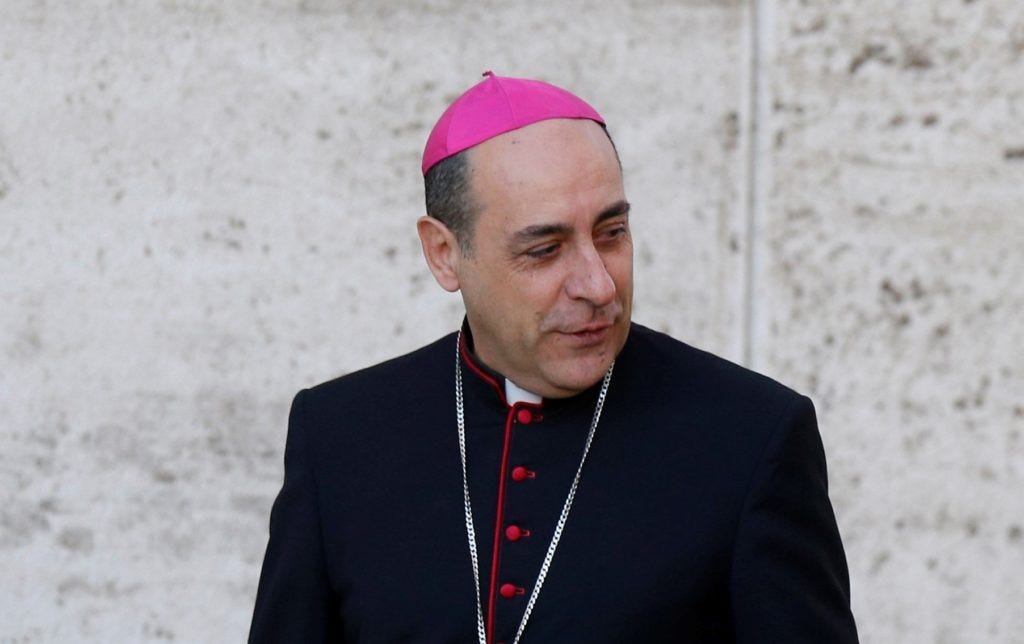
I think the first consistory of 2026 has already been thoroughly denounced for what it was—a clown show—and that not much more needs to be said about it.
However, as part of yet another episode of You Can’t Make this Crap Up, I would like to highlight some lesser-reported comments by Cardinal Víctor Manuel Fernández, aka “Cardinal Soft Porn,” which seem to have slipped through the media cracks. Keep in mind that this man leads the very serious Vatican body (Dicastery for the Doctrine of the Faith) charged with promoting and protecting the Catholic faith and morals. As usual, Captain Smooch was a bastion of “orthodoxy.” (I am being sarcastic.)
Fernández’s address to the first consistory of Pope Leo XIV, centered on Evangelii Gaudium and the primacy of the kerygma (“proclamation of the Gospel”), presented itself as a missionary refocusing but instead reiterated a theological framework that weakens the Church’s doctrinal integrity, moral clarity, and apostolic continuity under the guise of “pastoral renewal.” Thus, the nauseating obsession with “renewal” continues. “Substitution” would of course be a more accurate term, since they are not renewing anything but replacing the Catholic faith with an alien, man-made religion.
Fernández repeatedly insisted that the Church must not engage in an “obsessive proclamation of doctrine and norms” but instead concentrate on the kerygma as the “heart” of the Gospel. This is modernist synodal sorcery at work. In Catholic tradition, the kerygma is not a vague announcement of divine love detached from concrete truths and commandments. The apostolic kerygma always included a call to repentance, conversion, baptism, and obedience to the teaching handed down by the Apostles. But that would not sit well with Prevost, Fernández & Co.’s Disneyland Catholicism.
By opposing “proclamation” to “doctrine,” Fernández implicitly separates what God has joined together. The Church does not first announce an encounter and only later—optionally—introduce doctrine. Rather, the encounter with Christ is mediated precisely through revealed truth, sacramental life, and moral teaching. A kerygma emptied of doctrinal substance becomes an emotional appeal rather than the proclamation of saving truth. This saving truth is, of course, “the Gospel,” but an entire separate article could be written on how “the Gospel” signifies something fluid and elusive for the Synodal Church, whose prelates have occupied the Catholic Church’s buildings and structures.
Fernández emphasized that “not all truths of the doctrine of the Church have the same importance,” distinguishing a “core” from the rest. While the Church does recognize an order among truths, this principle is frequently misused in contemporary theology to relativize teachings that are unpopular or countercultural.
The danger here is not theoretical but practical. In recent decades, this language has often been used to marginalize clear moral teachings—especially on life, sexuality, marriage, and natural law—by branding them as “secondary,” “contextual,” or pastorally inconvenient. Yet these teachings flow directly from the Gospel and from the lordship of Christ over all of human life. They are not optional appendices to the kerygma but its concrete implications.
The repeated contrast between “heart” and “rules” is pastorally attractive but theologically flawed. May I remind you again that this man is supposed to be in charge of promoting and protecting the holy truths handed down by the Apostles, yet his little “missionary reframing” is infantile in its stupidity and satanic in its dangerous nature. Divine law is not an arbitrary imposition added after the fact; it is an expression of God’s wisdom and love. Christ Himself says, “If you love me, keep my commandments.” To suggest that moral and doctrinal norms somehow obscure the Gospel is to misunderstand their role in forming authentic Christian freedom. I doubt Fernández is misunderstanding anything. His twisted perversion of Catholicism is intentional and carried out at the behest of his boss’s ongoing Bergoglian campaign to destroy the Catholic Church.
For the past sixty-odd years, the Church has deemphasized moral clarity in the name of pastoral sensitivity, and confusion, chaos and destruction—rather than conversion—has followed.
Fernández called for a “synodal missionary reform” that places in the background whatever does not directly serve the first announcement. This raises a crucial question: who decides what no longer serves? Without clear doctrinal criteria, reform becomes a slave to cultural pressures.
Authentic reform in the Church has always meant a return to the sources—Scripture, Tradition, the Fathers, and the liturgy—not a selective sidelining of elements deemed difficult or demanding. The Counter-Reformation stands as a beautiful example of true Catholic reform.
Finally, Fernández’s emphasis on enthusiasm, motivation, and missionary fervor—while good in themselves—lacks a corresponding emphasis on catechesis, discipline, and formation. The Church’s current crisis is not due to excessive doctrine, but to decades of inadequate transmission of the faith.
Missionary zeal without solid formation produces fragile believers, vulnerable to secular ideologies and moral compromise. True evangelization forms disciples, not merely sympathizers.
Cardinal Fernández’s intervention reflects a vision of the Church that prioritizes immediacy, affectivity, and flexibility at the expense of doctrinal rigor and moral clarity. While the kerygma is indeed central, it cannot be abstracted from the fullness of Catholic teaching without being distorted.
If I may translate and summarize the Prefect’s call: he is urging the “cardinals” to proclaim not the beauty, coherence, and demanding truth of the Catholic faith, but the satanic Synodal Religion.
Frankly, Fernández couldn’t care less about the “doctrine and norms” of the Catholic Church.
Our Lady, Co-redemptrix, pray for us…
Our Lady, Mediatrix of all Graces, pray for us…
Viva Christo Rey!
Also Read:
All Christian Life Is Posited on Acceptance of Reality
Why the Consistory Is Officially Just Another Synodal Dumpster Fire — A Short Overview
Video: Radical Fidelity Sits Down With Kokx News & WM Review to Discuss the Future of TLM
Why Father Louis-Marie de Blignières’ Proposal for the TLM Should Be Rejected
Parish Hell-bent on Profaning Epiphany in Order to Compromise with False Religion
On the Hidden Meanings of Logos (And the Dire Consequences of Rejecting It)
Cardinal Víctor Manuel Fernández is exhibit A for why we cannot trust "Pope Leo." The buck stops with the pope and his silence in the face of heresy and apostasy is deafening.
Just another bit of evidence that the Conciliar Church is the false church of satan! One well placed boot in that fake cardinal's backside is definitely called for!